

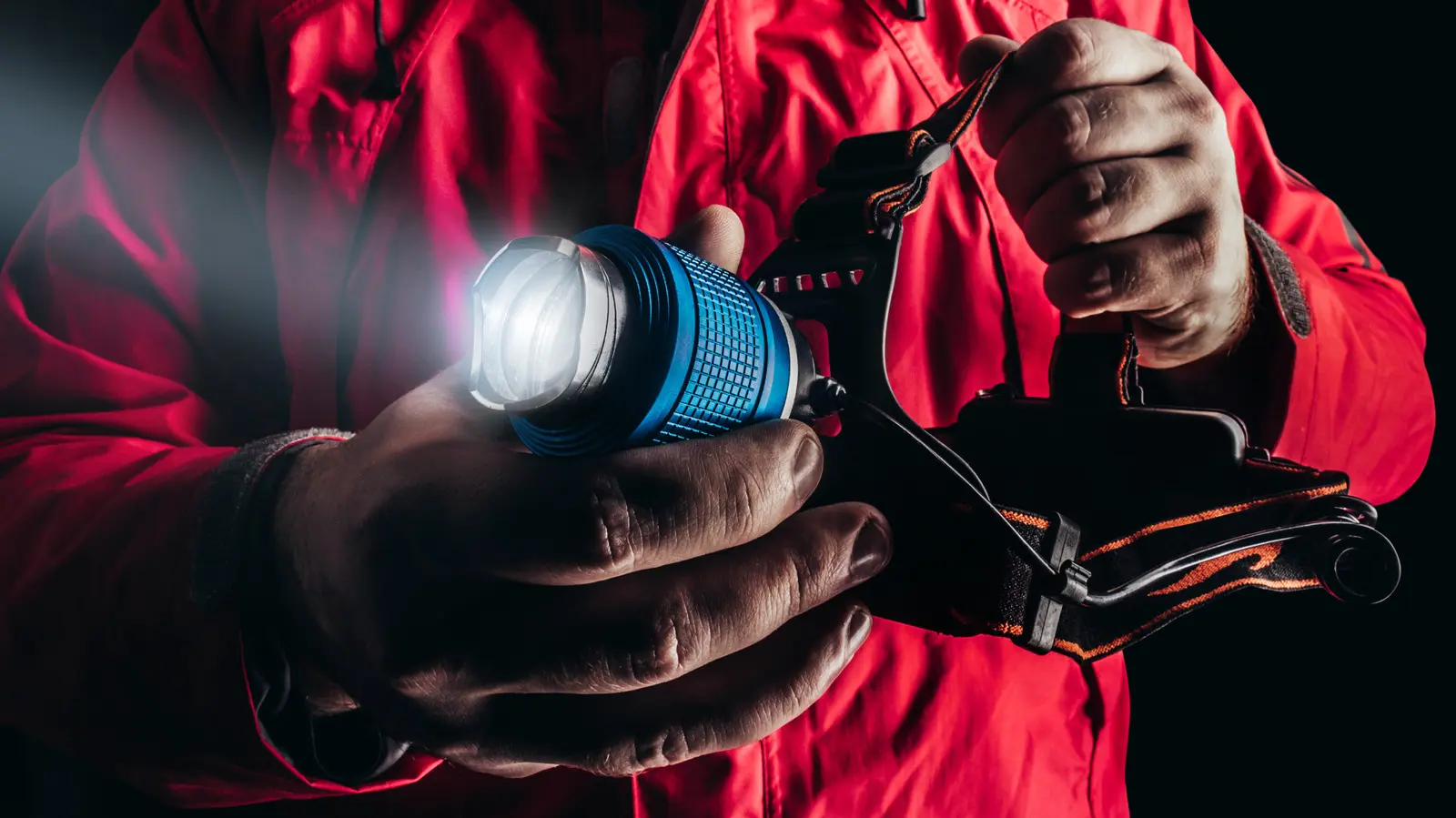
When browsing the best rechargeable flashlights for your next outdoor adventure, it's easy to get caught up in differences like cost and manufacturer. But when it comes to the flashlight's capability, it's important to know that more lumens isn't always better. In fact, if you choose a model that has over 1,000 lumens, you've probably got more light than you actually need. Many seasoned campers and hikers have learned this lesson the hard way, after investing in high-output lights that ended up being overkill for their typical nighttime activities.
Typically, around 300 up to 1,000 lumens is the sweet spot for most camping and hiking environments. This range provides enough brightness for everyday outdoor activities such as setting up a tent, cooking dinner, reading a map, or walking short distances in the dark. It offers sufficient illumination without being so intense that it washes out your vision or disturbs your eyes' natural adjustment to low light. Higher-powered flashlights from the most popular flashlight brands can be helpful in some situations, especially when you need to see farther distances or if you're looking for specific, hard-to-find things in the underbrush. But hanging out around a campsite usually doesn't require anything more than a device with lower output.
Understanding Lumens and Practical Light Output
Lumens measure the total amount of visible light emitted by a source per unit of time. For a flashlight, the lumen rating describes the brightness of the beam at its source, not how far the light travels or how evenly it spreads. A 1,000-lumen flashlight can appear very bright in a small area, but its beam might be narrow and concentrated, making it less useful for broad campsite illumination. Conversely, a 300-lumen flashlight with a wide flood beam can light up a large area effectively.
It's essential to understand that the human eye perceives brightness logarithmically, not linearly. Doubling the lumen output does not make the light appear twice as bright. For example, a 500-lumen light looks only about 25% brighter than a 250-lumen light under real-world conditions. This logarithmic relationship means that chasing ever-higher lumens yields diminishing returns in perceived brightness while significantly impacting battery life and heat management.
Using a flashlight with a higher lumen rating also comes with an important power trade-off. You may get the best shine from a high-powered flashlight, but that increased brightness requires more energy and can thus reduce battery life. A typical 1,000-lumen flashlight running on high mode might last only 1-2 hours, while a 300-lumen light on similar batteries could run for 5-8 hours. Additionally, the National Park Service notes that more light is not always better when spending time outside, as it can obscure natural darkness. It can also impact natural resources, wildlife, and the overall outdoor experience. Bright lights can disorient nocturnal animals, disrupt mating behaviors, and reduce the opportunity to see stars or bioluminescent organisms.
How Flashlight Design Impacts Performance
While lumen strength is important when selecting the best lighting gear options for your camping trip, it actually doesn't tell you the whole story. The lumen rating of a flashlight measures the light output from the bulb and reflector that is concentrated into the beam itself. So the higher the lumens, the more intense the beam is. But it does not measure just how far the light will travel or how effectively it will light up an area.
Beam distance, beam intensity, and beam type all play a role in how useful a flashlight will perform in different outdoor situations. For example, a wider flood beam is good when working around the campsite, while a more focused beam is better when walking on a trail at night. This means the brightest flashlight on the market is not always the best choice. A flashlight's design and how it actually distributes light can be just as important as its overall lumen output.
Different flashlight types are suitable for different activities. Smaller flashlights are easy to carry and can work well as backup options, while larger models can provide enough power in moments when you need to light up a bigger area. Headlamps are a good option, because you can keep both hands free while hiking, setting up camp, or doing things after dark. The level of versatility in some flashlights can vary, which is why it's best to choose options that can handle more than one task.
Beam Distance and Intensity Explained
Beam distance (often given in meters) indicates how far the flashlight can shine before the light drops to the equivalent of a full moon (0.25 lux). A focused thrower flashlight might have a beam distance of 500 meters even with only 500 lumens, while a flood light with 1,000 lumens may only reach 150 meters. For camping, a balanced beam distance of 100-200 meters is usually sufficient for most tasks, from spotting trail markers to finding your way to the bathroom.
Intensity is measured in candela and describes how concentrated the beam is. High-candela lights produce a tight hotspot that can illuminate objects far away. Low-candela, high-lumen lights produce a wide, even beam that is perfect for nearby work. Many modern flashlights offer adjustable focus (zoom) that allows you to switch between flood and throw, though these often sacrifice some efficiency and waterproofing.
Battery Types and Runtime Considerations
Battery choice directly affects lumen output and runtime. Common options include disposable alkaline, rechargeable lithium-ion (18650, 21700), and built-in USB rechargeable batteries. For camping, rechargeable lithium-ion cells are popular because they offer high capacity (typically 2,500-5,000 mAh) and can be recharged via solar panels or power banks. Alkaline batteries are widely available but have lower capacity and voltage drop under load, meaning high-lumen lights will dim quickly on alkalines.
A good rule of thumb: a 300-lumen flashlight on a single 18650 battery can run for about 4-6 hours on high, while a 1,000-lumen light on the same battery will last only 1-2 hours. Many quality flashlights offer multiple brightness modes, including a low mode (10-50 lumens) that can extend runtime to 50+ hours, perfect for conserving power when you don't need maximum brightness.
Color Temperature and CRI
Modern flashlights use LEDs with varying color temperatures, measured in Kelvin (K). Cool white (6000-6500K) appears harsh and can wash out colors but often appears brighter to the eye. Neutral white (4000-5000K) provides a more natural appearance and reduces glare off foliage. Warm white (2700-3500K) is easier on the eyes in fog or dust and is less likely to disturb wildlife. For camping, a neutral to warm LED (around 4000K) is often recommended for the best balance of visual clarity and comfort.
Color Rendering Index (CRI) measures how accurately a light source reveals the colors of objects compared to sunlight. High CRI (90+) flashlights are important for tasks like identifying trail markers, checking map colors, or distinguishing poisonous berries. Many budget flashlights have a CRI of 70 or lower, which can make objects look washed out. For camping, look for lights with CRI 80 or higher.
Durability and Weather Resistance
A camping flashlight must withstand rain, drops, and dirt. IPX ratings indicate water resistance: IPX4 (splash resistant) is minimum, while IPX7 (submersible to 1 meter for 30 minutes) or IPX8 (submersible deeper) is ideal. Also consider impact resistance – many quality lights can survive a 1-meter drop onto concrete. Anodized aluminum bodies are standard for heat dissipation and durability. For cold weather camping, lithium-ion batteries lose capacity faster, so having a light with a separate battery compartment or a mechanical lockout can help preserve charge.
Practical Tips for Choosing Your Camping Flashlight
Start by assessing your typical camping activities: if you mostly stay at a fixed campsite, a floody headlamp or a small lantern may be enough. If you night-hike, a light with a moderate throw (around 150-200 meters) and a medium lumen output (400-600 lumens) is ideal. Always carry a backup light, such as a small keychain flashlight, in case your main light fails. Look for lights with a simple user interface – too many modes can be frustrating in the dark. Magnetic tailcaps are convenient for attaching the light to metal surfaces, freeing your hands. Lastly, consider the weight: a lightweight 200-lumen flashlight might be preferable for backpacking, while a heavier 1,000-lumen model could be fine for car camping.
In summary, the ideal camping flashlight balances lumen output, beam type, battery runtime, and durability. While the market offers lights ranging from 50 to 5,000 lumens, most campers will find the 300-1,000 lumen range to be the most versatile and practical. Remember that a well-designed flashlight with an appropriate beam pattern and reliable battery system is far more valuable than a raw lumen count. By focusing on these factors, you can select a flashlight that enhances your outdoor experience without overwhelming the natural darkness or draining your resources.
Source: SlashGear News