

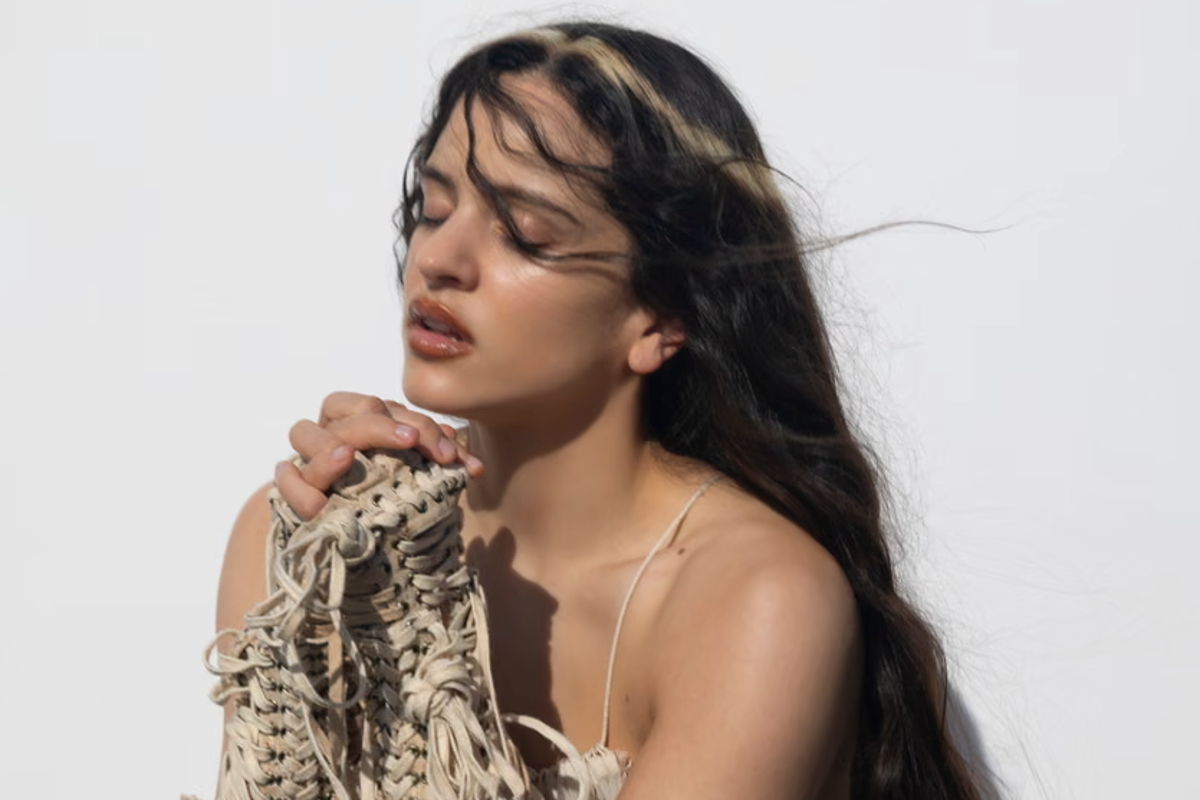
In a recent Instagram post, Spanish singer Rosalía shared a selfie from New York’s Metropolitan Museum of Art, a painting behind her. Those paying attention will have spotted that the work in question was Saint Rosalie Interceding for the Plague-stricken of Palermo by Anthony van Dyck (1624). It depicts Saint Rosalia intervening during a plague that struck the city shortly after the Flemish artist arrived. The epidemic killed much of the population. When her purported remains were discovered, they were paraded through town as the plague abated, and she became Palermo’s patron saint. Grateful to be alive, Van Dyck repurposed a self-portrait sketch into the extraordinary work that hangs in the Met today.
Rosalía’s fourth album, Lux, is a masterpiece evoking its own themes of sainthood, faith, mortality and (love)sickness, with a self-portrait hiding underneath. Split into four movements, it is an epic work in which the 33-year-old sings in 13 different languages, accompanied by traditional fada singers and the resplendent London Symphony Orchestra. Her innate curiosity in bringing different sounds together is more palpable than ever, as she told Billboard: “I think that in order to fully enjoy music, you have to have a tolerant, open way of understanding it. Because music is the ‘4’33”’ of John Cage, as much as the birds in the trees for the Kaluli of New Guinea, as much as the fugues of Bach, as much as the songs of Chencho Corleone. All of it is music. And if you understand that, then you can enjoy in a much fuller, profound way.”
It’s amusing, in light of such nuanced remarks, to see the fuss being made in the classical music community over whether Lux can be described as such. Critic Hugh Morris dismissed lead single “Berghain” as “new musical kitsch” and accused Rosalía of perpetuating the “genrefication” of classical music, and of using “pre-digested musical gestures as a shortcut to depth or emotional power”. This feels particularly self-defeating in 2025, when one pop song feels very much like another, and a melody can be easily traced back to one that came two or three decades before. In short: spare us the gatekeeping. Rosalía is doing something different, and she’s doing it really, really well.
Continuity and Evolution from Motomami
Just as its predecessor, 2022’s Motomami, masterfully brewed a heady concoction of flamenco, reggaeton, dance, rap and pop, Lux brings together flamenco, fada, Romantic-era opera, Baroque, electronic and indie. In fact, early reviewers have made much of how different Lux is from Motomami, while virtually nothing has been made of the many similarities. Each song erupts from the former, constantly shifting and evolving in sound while maintaining a powerful throughline in theme and production. Her themes of deception, change and transformation, too, are continued from songs such as Motomami opener “SAOKO”, on which she sings in Spanish: “When the little ice cubes ain’t water no more/ Now they’re ice, frozen… When the horse enters Troy/ You trust it and then it burns.” On the chorus, she asserts: “I’m very much me, I transform/ A butterfly, I transform/ Drag queen makeup, I transform.” Now think of that dissolving sugar cube on “Berghain”, and the accompanying music video in which she transforms into a dove.
Musical and Lyrical Analysis
There are dramatic violins and a tremendous, electronically enhanced throb of the cello on “Porcelana” as Rosalía sings in Spanish, a dark mutter over flamenco handclaps. The orchestration swells, then gives way to sharp piano, shivery flurries of strings and a brass section. Celestial choirs are paired with increasingly tense instrumentation, lifting higher and higher. “Mio Cristo” is a stark, almost hymnal work, with her tremulous vocals landing over a piano arrangement that flits from simple to splendid. No matter whether you understand her Spanish lament, her storytelling through voice is masterful, building to a jaw-dropping falsetto: “Queen of chaos/ Because my God made me this way.” “La Perla” glides around a waltzing acoustic guitar, her autotuned voice coquettish in tone as she offers up lyrics that eviscerate the man foolish enough to draw her ire: “Gold medal in being a motherfer/ You’ve got the podium of disappointment/ Local fiasco/ National heartbreaker/ Emotional terrorist/ World-class f-up.”
Themes of Feminine Mysticism and Sainthood
Rosalía has stated that the album is anchored in ideas of “feminine mysticism”, in particular the ways in which female saints have navigated lust, mortality and the fallible nature of humans. Sometimes she emulates that notion of giving away all material goods to attain a spiritual transcendence; in the case of “Sauvignon Blanc”, she promises to throw away her Jimmy Choos if it means she can be with the one she loves. “Nova Robot”, meanwhile, is inspired in part by Sun Bu’er, a Taoist master and poet who was renowned for her beauty – which she then destroyed by intentionally splashing boiling oil on her face.
St Rosalia appears to us once again on “Focu ’Ranni”, with the singer seemingly inspired by her origin story, rejecting a proposal to live as a hermit instead. “I’ll jump into the fire/ Before giving up my freedom,” she sings in Sicilian. Symbolism runs throughout, from purity to matrimony, as in closer “Magnolis” where the flower, often on display at weddings, is repurposed for her casket. She also explores power and celebrity obsession, having previously condemned fame as a “lousy lover” on Motomami’s “La Fama”. “Dios es Un Stalker” now positions her as a woman obsessed: “I’ve always been so spoiled/ and worn out by all this omnipresence.”
Vocal Performance and Emotional Authenticity
Most contemporary pop (with some exceptions, see Lola Young’s album I’m Only Fing Myself) is preoccupied with a clean vocal, leading to a dearth of real emotion in much of what we hear in the charts. As she proved with her first three albums, Rosalía has no such qualms. You can picture the tears on her face. On “Berghain”, her soprano cuts through the thunderous orchestra like a heavenly beam of light through thunder clouds. There’s humour, too: “That’s gonna be the energy,” she says, after hitting her big note on “Mio Cristo”. “And then…” CRASH comes the orchestral finale. It’s the musical equivalent of breaking the fourth wall, bringing you out of the song for just a moment. Music purists can entertain themselves all they like by debating whether this is “true” classical music. The rest of us can revel in what is possibly the best album of the year.
Rosalía’s journey from flamenco prodigy to global pop star has been marked by constant reinvention. Her debut, Los Ángeles (2017), was a stark flamenco album, followed by the experimental El Mal Querer (2018), which fused flamenco with pop and R&B. Motomami (2022) cemented her status as a genre-defying artist, winning multiple Grammy and Latin Grammy awards. Lux represents a further evolution, incorporating classical orchestration and operatic techniques while retaining her signature flamenco roots. The album’s title, Latin for “light”, reflects her search for illumination through art. Recording sessions took place across Madrid, London, and New York, with contributions from composer Raül Refree and producer El Guincho. The London Symphony Orchestra, conducted by Robert Ames, provides the sweeping cinematic backdrop.
The controversy over Lux’s classical identity mirrors debates that have followed every boundary-pushing artist. When Bob Dylan went electric, or when Miles Davis moved to fusion, purists cried foul. Rosalía’s fusion of flamenco, reggaeton, and classical might be jarring to some, but it is precisely this audacity that makes her work vital. The album’s structure in four movements recalls a symphony, yet its content is deeply personal and modern. Songs like “Berghain” explore club culture and nightlife, while “Mio Cristo” wrestles with faith. The use of multiple languages—Spanish, Catalan, English, French, Italian, Portuguese, Arabic, Sicilian, Latin, Galician, German, Japanese, and even fictional ones—underscores her global perspective.
Production-wise, Lux is a sonic feast. Drums are replaced with orchestral timpani, bass lines are carried by cellos, and melodies weave between flamenco guitar and electronic synths. The album’s dynamic range is vast, from whisper-quiet verses to explosive choruses. On “Porcelana”, the tension builds with each layer, reflecting the fragility of human relationships. “La Perla” uses humour as a weapon, a sharp contrast to the solemnity elsewhere. Rosalía’s vocal performance is notable for its versatility: she can move from a delicate murmur to a full-throated scream, from classical vibrato to flamenco grit.
The conceptual depth of Lux also invites comparison to other ambitious pop projects. Like Beyoncé’s Lemonade or Kanye West’s My Beautiful Dark Twisted Fantasy, it uses a unified theme to explore personal and universal issues. The album deals with the pain of love, the fear of death, and the desire for transcendence. The van Dyck painting mentioned at the outset serves as a visual metaphor: beneath the surface of religious iconography lies a self-portrait. Rosalía, too, hides her own vulnerabilities behind the mask of a pop star. In the end, Lux is a testament to the power of music to transform suffering into beauty.
Critics have already begun comparing Lux to the works of classical composers like Mahler and Debussy, while also noting its pop sensibility. The album’s length—nearly 80 minutes—might seem daunting, but every moment feels purposeful. There is no filler. The sequencing creates an emotional arc, from the chaotic energy of the opening tracks to the quiet resignation of the finale. Rosalía has described the album as a prayer, a confession, and a celebration. It is all these things and more. As the year progresses, Lux will likely dominate end-of-year lists and spark further debate about the future of genre. But for now, it stands as a singular achievement in 21st-century music.
Source: The Independent News