

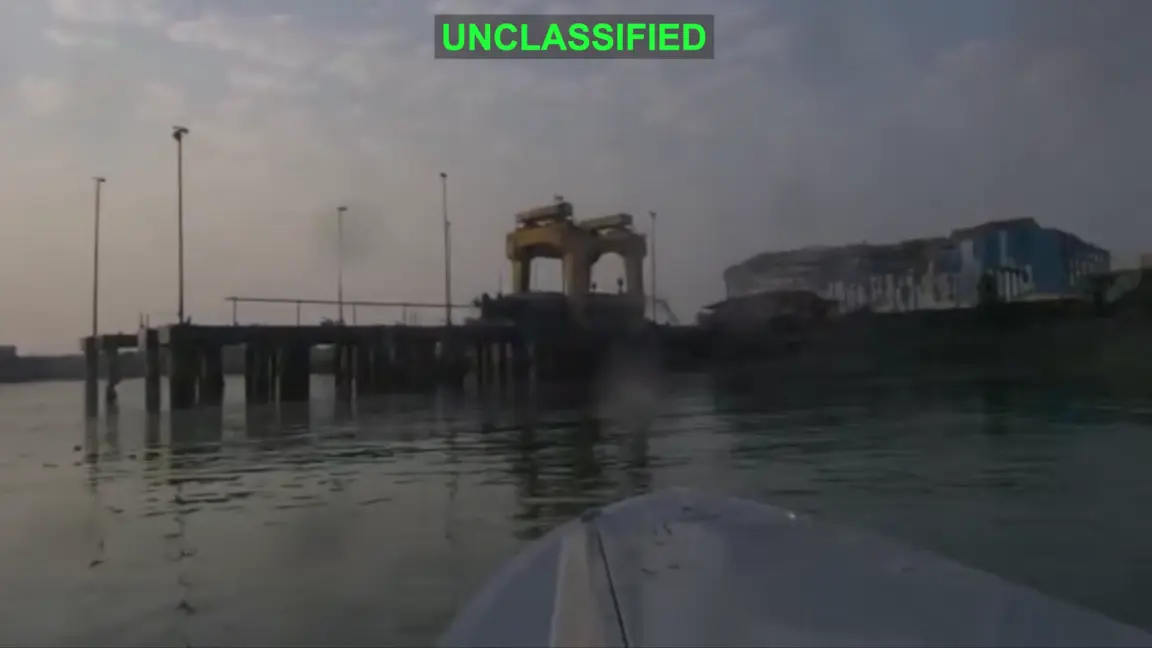
For the first time in its history, the United States military deployed explosive-laden drone boats in combat, attacking an Iranian midget submarine and a naval port. The unprecedented operation, which occurred on the night of July 12, 2026, marks a significant shift in American naval tactics, as the US adopts asymmetric strategies previously used by its adversaries. The US Central Command confirmed the strikes, describing them as the "first time American forces have employed sea drones in combat operations." This development comes nearly a decade after Iranian and Houthi forces first demonstrated such weapons, highlighting a rapid evolution in maritime warfare.
Key facts about the strike
- Date: July 12, 2026
- Targets: An Iranian Ghadir-class midget submarine suspended from a gantry at Bandar Abbas Naval Base, and a ship maintenance facility.
- Weapon: Saronic Corsair autonomous surface vessels, 24 feet long, capable of carrying up to 1,000 pounds over 1,000 nautical miles at speeds exceeding 34 knots.
- Tactic: The drone boats made a "low-speed, uncontested approach" before detonating, according to USNI News.
- Context: The strike was part of a broader US military offensive against Iran following the collapse of a ceasefire, including fighter jet and warship attacks.
The technology behind the operation, the Saronic Corsair, is a product of Saronic Technologies, a defense company based in Austin, Texas. The company describes the drone boat as fully autonomous, capable of long-range navigation, patrol missions, and loitering with minimal human control. For this specific mission, the Corsair was equipped with explosives, transforming it into a kamikaze weapon. This marks the second notable use of US drone boats in the conflict; on June 8, 2026, a Corsair rescued two US Army helicopter pilots after their AH-64 Apache was shot down by an Iranian Shahed drone off the coast of Oman.
Historical context: Drone boats in warfare
The United States is far from the first country to use exploding drone boats, often called kamikaze or suicide drones at sea. The first confirmed use occurred on January 30, 2017, when Houthi forces in Yemen struck the Royal Saudi Naval frigate Al Madinah with an uncrewed, remote-controlled boat. US Navy officials later assessed that the weapon was developed with Iranian technical assistance, reflecting Tehran's long-standing support for the Houthis. That attack changed the calculus of naval operations in the Red Sea and Persian Gulf, forcing navies to consider the threat of small, cheap, and elusive drone boats.
In the years since, drone boat technology has proliferated. Ukraine, lacking a traditional navy, has become a global leader in asymmetric maritime warfare since Russia's full-scale invasion in February 2022. Ukrainian forces have used explosive drone boats to strike Russian warships and tankers, forcing the Russian Black Sea Fleet to relocate to ports farther from Ukraine. Ukrainian drone boats have also achieved several military firsts: they have used missiles to shoot down Russian helicopters, served as platforms to launch flying drones against Russian air defenses, and even deployed armed ground robots in amphibious operations. These innovations have demonstrated that drone boats can be more than just one-way attack weapons; they can serve as versatile naval platforms.
Technical details of the Corsair drone boat
The Saronic Corsair is a relatively small autonomous surface vessel (ASV) designed for a wide range of missions. According to Saronic Technologies, the boat is 24 feet long, with a range of 1,000 nautical miles and a payload capacity of 1,000 pounds. Its top speed exceeds 34 knots, allowing it to keep pace with many naval vessels. The Corsair can operate autonomously without direct human control, using onboard sensors and algorithms for navigation, patrol, and loitering. It can also be controlled remotely if needed. The boat's modular design allows it to be equipped with various payloads, including surveillance equipment, electronic warfare systems, or explosives. For the July 12 strike, the Corsairs were loaded with explosives, turning them into guided torpedo-like weapons that could approach targets stealthily.
One notable capability of the Corsair is its ability to make low-speed approaches, reducing its radar and acoustic signature. This allowed the US drone boats to approach the Iranian naval base uncontested, as reported by USNI News. The choice of target—a Ghadir-class midget submarine out of the water—suggests that the US aimed to degrade Iran's asymmetric naval capabilities, as midget submarines are often used for covert operations in shallow waters. The simultaneous attack on the ship maintenance facility also aimed to disrupt Iran's ability to repair and maintain its fleet.
Strategic implications
The US decision to use drone boats in combat reflects a broader shift in military doctrine. For decades, American naval strategy relied on expensive, multi-mission vessels like aircraft carriers and destroyers. However, the war with Iran, which began on February 28, 2026, with the United States and Israel attacking Iran, has exposed vulnerabilities. The US military has lost dozens of costly MQ-9 Reaper drones, worth over $1 billion, to Iranian air defenses. In response, the Pentagon is now seeking cheaper, mass-producible systems, including drone boats and one-way aerial attack drones. The latter, known as LUCAS drones, are based on Iranian Shahed drones, further illustrating how the US is adopting tactics from its adversaries.
The use of drone boats also signals a recognition that asymmetric threats require asymmetric responses. Iran and its proxies have long used low-cost weapons to challenge US naval superiority. The Houthis, for example, have employed drone boats and anti-ship missiles to disrupt Red Sea shipping. By fielding its own drone boats, the US is attempting to compete in this new realm of maritime warfare. However, this approach also carries risks. The proliferation of drone boats could lead to an escalation of attacks at sea, as adversaries develop countermeasures such as electronic jamming, directed-energy weapons, or speedboats equipped with machine guns.
The future of naval combat
The July 12 strike is likely just the beginning of expanded US drone boat operations. As President Donald Trump ramps up the war with Iran following the collapse of a ceasefire, the military is expected to continue using these assets alongside conventional forces. The success of the Corsair in both rescue and combat roles suggests that drone boats may become a permanent fixture in the Navy's arsenal. The Pentagon is currently working on acquiring a new generation of cheaper surveillance and strike drones, and drone boats fit neatly into that vision.
Meanwhile, other nations are watching closely. China, Russia, and North Korea have all invested in drone boat technology, and the US combat debut may accelerate their own programs. The naval domain is becoming increasingly crowded with uncrewed systems, from underwater drones to surface vessels. The challenge for navies will be to integrate these systems effectively, ensuring they can operate alongside manned ships without compromising safety or command-and-control. The US military's use of drone boats in combat marks a turning point, but it is only one chapter in a longer story of how warfare is being transformed by autonomy and affordability.
The development also raises ethical and legal questions. The use of kamikaze-style drone boats blurs the line between guided munitions and autonomous weapons. While the Corsair operated with human oversight, future systems could be fully autonomous, making decisions about targeting without direct human input. International humanitarian law requires that weapons distinguish between combatants and civilians, and that they be used proportionally. As drone boats become more prevalent, militaries must ensure they comply with these principles. The United States has stated that all weapons, including drone boats, are used in accordance with the law of armed conflict, but the rapid pace of technological change may outpace legal frameworks.
For now, the successful use of drone boats by the US military represents a new capability that allows for precise, low-risk strikes against high-value targets. The attack on the Iranian submarine and naval base demonstrated that drone boats can penetrate defended waters and deliver a lethal payload. As the war with Iran continues, the US military will likely rely more heavily on these and other uncrewed systems to maintain its edge while saving money and reducing pilot casualties. The era of the drone boat has truly arrived.
Source: Ars Technica News