

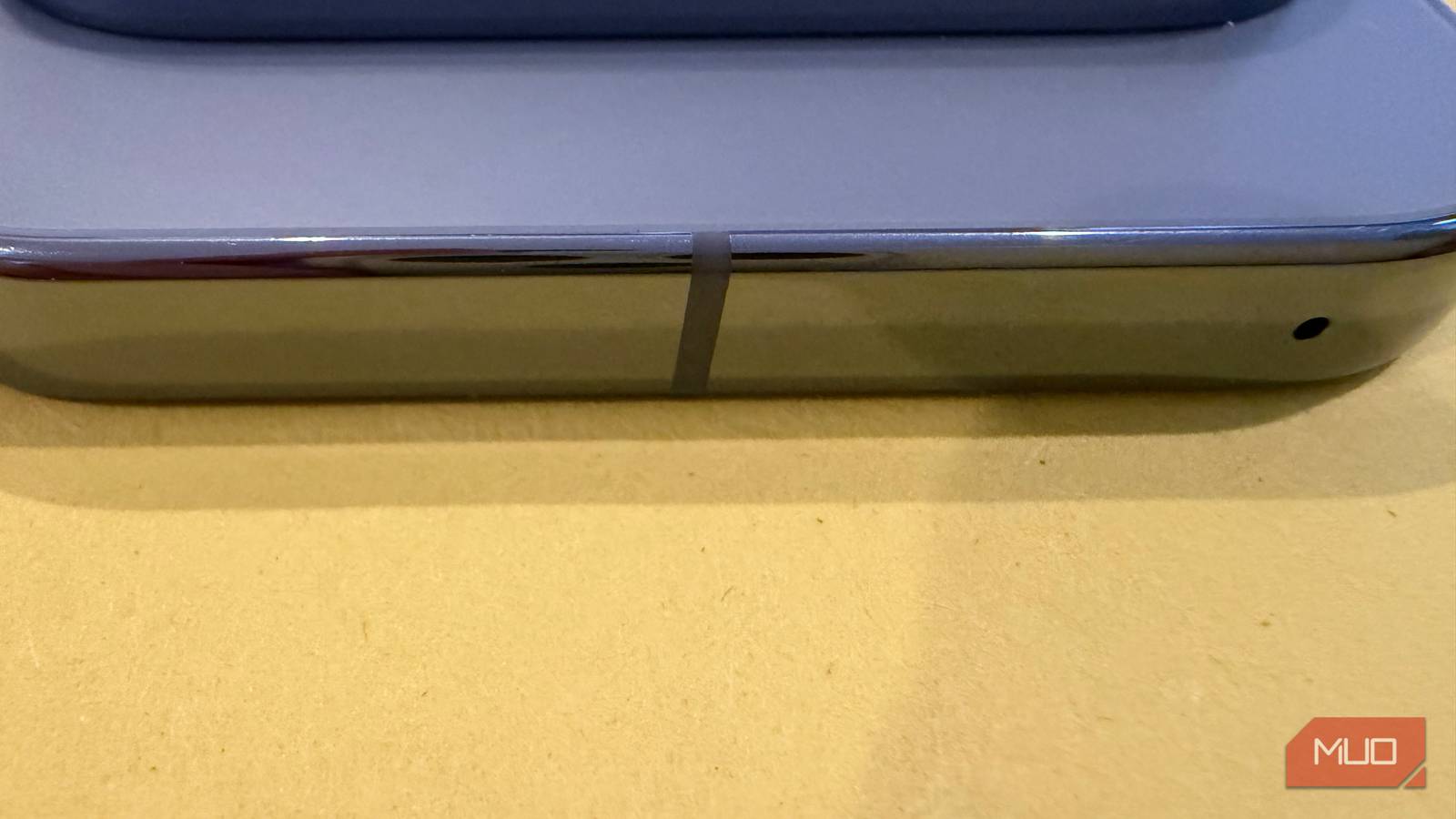
Have a look at your phone. Chances are, it has random lines integrated into the frame—perhaps on the side rails or along the back. You might even notice an oval-shaped cutout that looks similar to a fingerprint scanner, but it's not. These features aren't for looks; honestly, they're kind of ugly. They exist to solve an engineering problem every device maker has faced since phones moved to metal unibody construction.
What Are These Weird Lines and Cutouts on My Phone?
They're Not a Design Choice — They Are a Forced Compromise
Older phones, such as the metal HTC One M7 from 2013, awkwardly placed lines on the back as dividers between various components. Later, manufacturers figured out how to place these lines along the edges, allowing the back to be a clean surface with no interruptions, as seen on many modern devices like the Galaxy S22 and iPhone Air.
The lines are typically made of plastic or composite material. They are not decorative; they are essential for wireless communication. Without them, a metal phone would effectively become a Faraday cage, blocking cellular, Wi-Fi, Bluetooth, and GPS signals.
The Problem: Metal Is the Enemy
Metal Blocks Wireless Signals
Before the switch to metal, most phones were made of plastic. Plastic was lightweight, durable, and critically did not interfere with the transmission of wireless signals. In the early 2010s, phone manufacturers moved to metal unibody phones, often cut from a solid block of aluminum. This shift served multiple purposes: metal looked and felt premium, provided better heat dissipation, and offered structural rigidity for thinner designs. However, metal also presented a major engineering challenge: how would wireless signals escape the phone? A metal phone is essentially a Faraday cage, which blocks electromagnetic fields.
The Solution: Plastic/Composite Lines or Glass Windows
Manufacturers created openings for wireless signals by using plastic or composite lines in the metal frame, or by incorporating glass cutouts on the back. The latest pro iPhones and Pixel devices feature a glass visor or window. A secondary benefit of glass cutouts is that they allow wireless charging, which is impossible with a fully metal phone. Samsung's glass back panels, which look and feel like metal, serve the same purpose.
What About That New Large Oval on Phones?
That's Your mmWave 5G Antenna Cutout
On some devices, you might notice a large oval cutout along the edge, resembling a fingerprint scanner. This is the mmWave 5G antenna cutout, designed for the ultra-rare, almost non-existent flavor of 5G that was supposed to bring gigabit-level speed and ultra-low latency. However, mmWave networks are rare except in densely populated areas, and they are expensive, short-range, and battery-consuming. Chances are your phone has never used this antenna and probably never will. The lack of mmWave networks makes the antenna lines even more critical, enabling your phone to use low- and mid-band 5G and 4G/LTE.
The evolution of phone materials has been driven by the need to balance aesthetics, durability, and signal performance. Early smartphones used plastic because it was cheap and radio-frequency transparent. As consumers demanded premium feel, manufacturers turned to metal, which forced them to add plastic strips. Today, the most common solution is the 'glass sandwich'—glass front and back with a metal frame. This design allows signals to pass through the glass while maintaining a premium metal feel on the edges. The glass can also be treated for scratch resistance and can incorporate wireless charging coils.
Understanding these lines helps appreciate the complexity of modern smartphone engineering. Every line is a deliberate compromise between form and function, ensuring that your phone stays connected despite its metal skeleton.
Historical context: The shift to metal began with the iPhone 4's stainless steel band and was quickly adopted by Android manufacturers like HTC and Samsung. However, early metal phones like the HTC One M7 suffered from signal issues, leading to the iconic plastic strips. Later, companies like Apple refined the design with Precision CNC milling and injection-molded plastics. The introduction of 5G added another layer of complexity, requiring more antennas and thus more cutouts. Some phones, like the Google Pixel 6, integrated a prominent camera visor that doubled as a signal window.
Today, almost all flagship phones use a glass sandwich. The frame remains metal for rigidity, while the glass back allows for wireless charging and better signal reception. Some manufacturers, like Sony and Xiaomi, still experiment with full-metal backs paired with separate antenna windows, but the glass sandwich is the dominant design.
The mmWave antenna cutout is a particularly interesting case. In the United States, carriers like Verizon and AT&T invested heavily in mmWave, but coverage remains limited to stadiums, airports, and city centers. Outside the US, mmWave is even rarer. As a result, many global variants of phones omit the mmWave cutout entirely. This disparity illustrates how regional network differences influence hardware design.
In summary, those lines and cutouts are not blemishes but essential components. They represent the ongoing struggle between industrial design and antenna engineering. Next time you pick up your phone, take a moment to appreciate the invisible technology that keeps you connected—right through those seemingly awkward lines.
Source: MakeUseOf News