

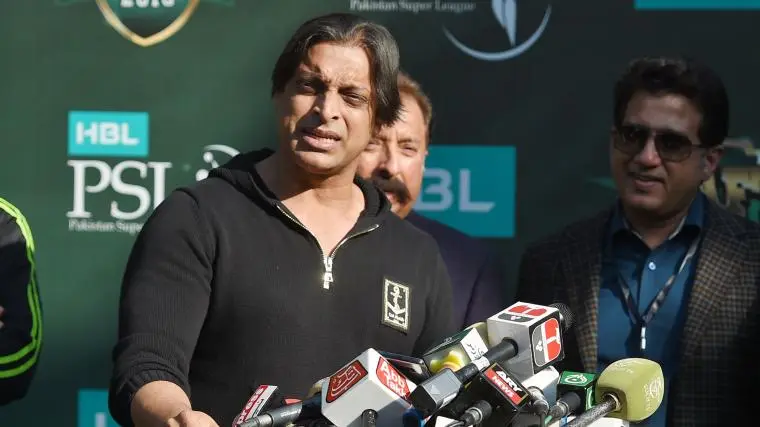
Shoaib Akhtar, the former Pakistan fast bowler renowned for his blistering pace and fiery persona, has drawn a playful yet striking comparison between himself and Brazilian football icon Ronaldo Nazario. In a recent interview, the 'Rawalpindi Express' suggested that had he chosen football over cricket, his style on the pitch would have mirrored that of the iconic striker known simply as R9. The comments have sparked intrigue among fans of both sports, blending two worlds that rarely intersect in such a personal manner.
Akhtar, who retired from international cricket in 2011 after a career studded with records and controversies, has never shied away from bold statements. His latest musings on football, a sport he has often expressed admiration for, came during a discussion about the 2026 FIFA World Cup. The tournament, hosted by the United States, Canada, and Mexico, saw Spain lift the trophy after a dominant campaign, defeating Argentina in a final that has already become the subject of debate and analysis.
But it was Akhtar's self-assessment that captured headlines. Speaking in a relaxed tone, he said, 'First of all, what kind of footballer would I have been? I would have been like Nazário. R9. And brother, if I ran properly, then R9, CR7 would be left behind. By the way, if I think about Shoaib bhai, I am reminded of Zidane too. I would have hit a lot! I would have broken many legs!' The remarks, delivered with characteristic bravado, underscored the cricketer's belief in his athletic prowess and his willingness to inject humor into serious discussions.
Shoaib Akhtar Picks His Football Alter Ego
Akhtar's comparison to Ronaldo Nazario is not as far-fetched as it might first appear. Both athletes are known for their explosive speed, physical strength, and an almost supernatural ability to dominate their respective arenas. Ronaldo Nazario, often hailed as one of the greatest strikers of all time, terrorized defenders with his dribbling, finishing, and sheer power, especially during his peak years in the late 1990s and early 2000s. His 2002 World Cup performance, where he scored eight goals and led Brazil to their fifth title, remains a gold standard for strikers. Akhtar, meanwhile, was the fastest bowler in cricket history, regularly clocking speeds above 160 km/h and leaving batsmen scrambling for cover.
The Pakistan legend leaned into the comparison, joking that his pace would have left even Cristiano Ronaldo struggling to keep pace. 'If I ran properly,' he quipped, 'then R9, CR7 would be left behind.' This playful boast highlights a common trait among elite athletes: the belief that raw athletic ability can translate across disciplines. However, Akhtar was quick to acknowledge that football requires more than just speed. 'I would have been like Zidane too,' he added, referencing the French maestro's grace and vision, 'but I would have hit a lot. I would have broken many legs!' The contrast between Zidane's elegance and Akhtar's combative approach underscores the cricketer's self-awareness about his aggressive nature.
It is worth noting that Akhtar's career was marked by controversies surrounding his bowling action and temperament, but also by moments of brilliance that earned him a place among cricket's all-time greats. His fastest recorded delivery—161.3 km/h (100.2 mph) against England in 2003—remains a record. If that pace were transferred to a football pitch, it would manifest as explosive acceleration and top speed, traits that made Ronaldo Nazario so lethal on the counterattack. Yet, as Akhtar himself acknowledged, technical skills can only be honed through years of specialized training. Still, the comparison serves as a delightful thought experiment for fans of both sports.
Praise for Messi and Spain's Dominant World Cup Run
Akhtar's football commentary did not stop with self-comparisons. He turned his attention to Lionel Messi, calling him 'the greatest man to walk on planet Earth as a footballer.' This is high praise from a man who has shared dressing rooms with cricket legends like Wasim Akram and Brian Lara. Akhtar specifically highlighted Messi's incredible trophy collection: eight Ballon d'Or awards and 48 career titles. He also marveled at the Argentine's enduring fitness, noting that 'recently, just in a month, he played around 18 hours of football. 18 to 22 hours of football he played.' While the exact figures may be debatable, the sentiment reflects the widespread admiration for Messi's longevity and work ethic.
The 2026 World Cup final, in which Spain defeated Argentina 2-1, was a source of both disappointment and respect for Akhtar. He praised Spain's tactical acumen, saying, 'Their composition, their attack, their changes... ever since the rules changed, five substitutes and one extra substitute in extra time, when that came, I think Spain benefited the most from it.' Indeed, Spain's depth proved crucial in a tournament where matches stretched into extra time and fatigue played a decisive role. Manager Luis de la Fuente's ability to rotate players effectively, particularly in the knockout stages, was widely credited for Spain's success.
Akhtar also expressed admiration for the broader lineage of football greatness, tracing a path from Diego Maradona to Ronaldo Nazario, to Messi and Cristiano Ronaldo, and on to Kylian Mbappé and Neymar. 'You see for yourself, starting from Diego Maradona, to Nazário, to Ronaldo, to Messi, to CR7... reaching all the way here, to Mbappé, to Neymar... Because of these legends, football benefited so much. Because of these legends, how much football sold! Imagine the rights; where did the prices go? Imagine how many people got inspired!' This reflection underscores how football's commercial success is intertwined with the star power of its icons, a parallel Akhtar understands well given cricket's similar dependence on marquee players.
Cricketers Dreaming of Football Stardom Isn't New
Akhtar's comparison to Ronaldo Nazario is just the latest example of cricketers imagining themselves in the football world. The crossover between the two sports has a long history, particularly in nations where both are popular. For instance, former Indian batsman Virender Sehwag often joked that his hand-eye coordination would make him a natural striker, while Australian all-rounder Shane Watson once admitted he could have been a soccer player if not for cricket. More recently, England's Ben Stokes has been asked about his football skills, given his athletic background and father's career as a rugby league player.
However, Akhtar's case stands out because he explicitly linked his playing style to a specific football icon. His claim that he would have been like Ronaldo Nazario, coupled with his aggressive personality, paints a vivid picture of a footballer who would have combined power, speed, and a hint of menace. The 'broken legs' comment, while obviously hyperbolic, echoes the physicality of defenders from a bygone era, such as Paolo Maldini or Jaap Stam, who never shied away from tough tackles. Akhtar, who was known for intimidating batsmen with bouncers, would likely have brought a similar edge to the football pitch.
It is also interesting to consider the cultural aspects. In Pakistan, football has a growing following, particularly among younger generations, but cricket remains the undisputed national obsession. Akhtar's foray into football commentary helps bridge the gap, reminding cricket fans that their heroes can also appreciate and analyze the beautiful game. His praise for Spain's tactical innovation and Messi's genius may also inspire some cricket aficionados to follow football more closely.
Beyond the entertainment value, Akhtar's words offer a glimpse into the mind of an elite athlete. The tendency to imagine success in another sport is common among competitors who rely on raw talent and athleticism. But as he himself admitted, technical skill and years of specialized training are non-negotiable. Yet, in a world of hypotheticals, the thought of Shoaib Akhtar charging down a wing with the same speed that terrified batsmen is undeniably thrilling.
As the football world continues to digest Spain's victory and the end of an era for legends like Messi and Ronaldo, Akhtar's lighthearted commentary provides a refreshing cross-sport perspective. It humanizes the Pakistani legend, showing that even at the top of one discipline, athletes remain fans of other games. And if nothing else, it gives fans one more reason to debate the age-old question: who would win in a race between Shoaib Akhtar and Ronaldo Nazario? The answer, at least according to the Rawalpindi Express himself, is clear.
Source: Yahoo Sports News