

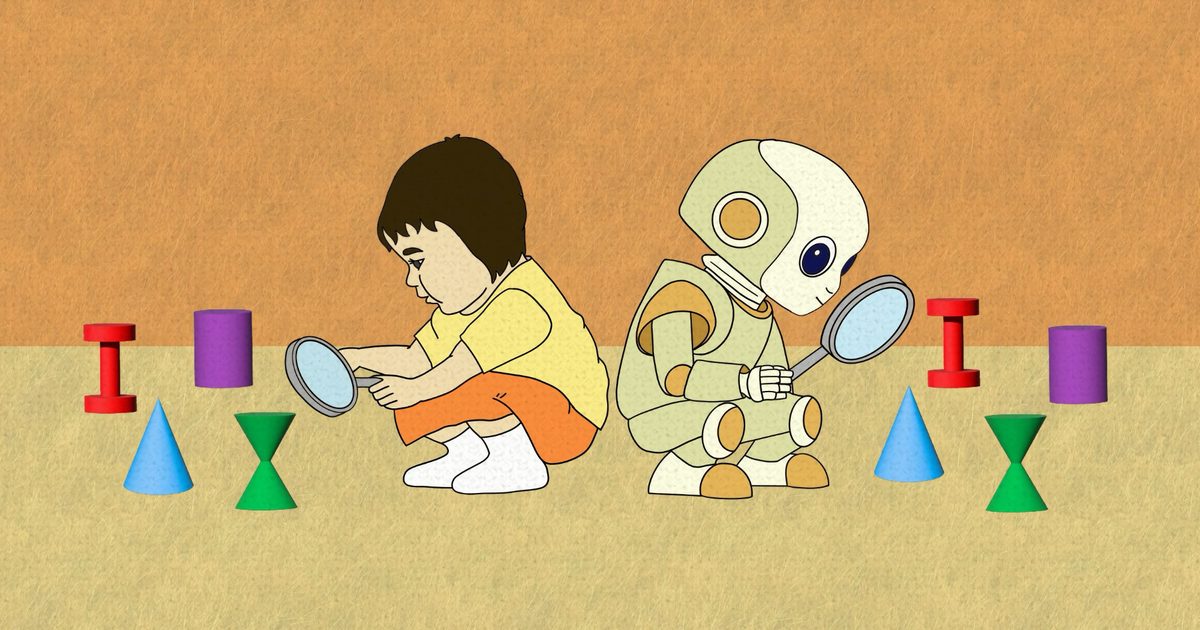
Scientists have long been puzzled by how toddlers pick up language so rapidly with minimal explicit instruction. A groundbreaking study from the Okinawa Institute of Science and Technology (OIST) may have uncovered a crucial piece of the puzzle: curiosity. In a new experiment, researchers created a virtual robot equipped with a brain-inspired neural network and set it loose in a simulated 3D world filled with shapes, colors, and simple commands like “push left magenta dumbbell.”
Some of the robots were programmed to receive rewards only when they completed tasks correctly. Others, however, got an extra internal reward for curiosity—essentially a dopamine-like signal triggered whenever they encountered something that challenged their existing understanding of the world. The results were striking: the curious robots achieved genuine language understanding in about half the time compared to their indifferent counterparts.
How Does Curiosity Help a Robot Learn Language?
The curious robots didn’t just edge out the baseline group; they blew past them. According to the study published in Science Advances, these robots reached a level of language comprehension that enabled them to generalize commands to new situations—something the non-curious robots struggled with. Study author Theodore Tinker compared the process to trying white chocolate for the first time even if you already love dark chocolate. “You take the risk anyway, and you walk away knowing more about chocolate in general,” he explained.
The key mechanism is that curiosity drives exploration. By seeking out novelty, the robots encountered a wider variety of linguistic input and physical interactions. This expanded their training data organically, accelerating the learning process. The curiosity reward essentially acted as an intrinsic motivation, pushing the robot to explore beyond the narrow set of tasks it was originally trained on.
Things got even more interesting halfway through training. The curious robots started knocking things over, manipulating objects in unprompted ways, and essentially playing. This spontaneous behavior was not programmed; it emerged naturally from the curiosity drive. The robots began to experiment with actions that were not part of any explicit task, which in turn exposed them to new linguistic contexts—for example, hearing a command like “push left magenta dumbbell” while they were already interacting with the dumbbell, reinforcing the association between the words and the action.
Do Robots Really Make the Same Mistakes as Toddlers?
One of the most fascinating findings was that the robots mimicked a well-known quirk in how children learn language. Kids often get certain verb forms right at first, then start applying grammar rules too broadly and make mistakes on verbs they previously used correctly, before eventually sorting out the exceptions and correcting themselves. The robots followed the same U-shaped dip in performance. For instance, they initially used past-tense forms correctly for irregular verbs like “go” (saying “went”) then overgeneralized to “goed” before later recovering to correct usage. This U-shaped learning curve is a hallmark of human language acquisition and had never been convincingly replicated in a robotic system before.
The study’s design contrasts sharply with how today’s large language models (LLMs) like ChatGPT learn. LLMs train on massive datasets—billions of words scraped from the internet—and then produce responses by predicting the statistically most likely next word. They don’t have intrinsic curiosity or a need to update internal beliefs based on surprises. The OIST robot’s brain, however, works more like a human brain: it prioritizes accuracy while trying to keep its existing beliefs intact, only updating them when something surprises it enough to be worth the cognitive effort. This makes learning more efficient and more analogous to how children learn with limited data.
Background on Language Acquisition and Machine Learning
Language acquisition in humans has been studied for decades, with theories ranging from innate grammar modules (Chomsky) to social interactionist approaches (Vygotsky). What most researchers agree on is that children are not passive recipients of language; they actively explore their environment, ask questions, and experiment with sounds and structures. This active learning is driven by curiosity. The OIST study provides a computational model that supports this view, showing that intrinsic motivation is not just beneficial but essential for efficient language learning.
In the field of machine learning, most successful language models rely on supervised learning or reinforcement learning with external rewards. Curiosity-driven exploration, also known as intrinsic motivation, has been studied in robotics and reinforcement learning but rarely applied to language acquisition. The OIST team’s approach is novel because it integrates curiosity directly into the learning algorithm and measures its impact on language comprehension.
The simulated 3D world contained various objects with different shapes, colors, and spatial relationships. The robot received commands in a simplified language, and its task was to carry out those commands. The curiosity reward was calculated based on the robot’s prediction error: if it could predict the outcome of an action accurately, it received no curiosity bonus; if its prediction was off, it received a positive reward. This encouraged the robot to try actions that had uncertain outcomes, leading to more diverse experiences.
By expanding the training to include exploratory actions, the curious robots effectively doubled their effective training data compared to the non-curious group, even though both groups had the same number of training steps. This efficiency gain is critical for real-world applications where data collection is expensive or time-consuming.
Implications for AI and Robotics
The findings have significant implications for developing more human-like artificial intelligence. Most current AI systems, including chatbots and voice assistants, require enormous amounts of labeled data and compute resources. A curiosity-driven learning system could potentially learn with far less data, mimicking the way children master language with only a few thousand hours of input. This could lead to more robust AI that generalizes better to new situations.
Moreover, the spontaneous play behavior observed in the curious robots suggests that intrinsic motivation might be a pathway to more autonomous AI agents that can learn without constant human supervision. In robotics, this could be revolutionary: imagine a robot placed in a household that explores its environment out of curiosity, learning the names of objects and the meaning of commands simply by interacting with them.
It’s important to note, however, that the OIST robot does not truly “understand” language the way humans do. It processes symbols and associates them with actions, but it lacks subjective experience or deep comprehension. Still, the behavioral similarities are striking and offer a new avenue for research into artificial consciousness and language grounding.
The study also raises questions about the role of surprise in learning. The curiosity bonus was triggered by prediction errors, which is similar to how the brain releases dopamine in response to unexpected rewards. This aligns with neuroscientific theories of learning and could bridge the gap between AI and cognitive science.
From a practical standpoint, these insights could improve voice-controlled robots designed for elderly care or manufacturing. By making robots curious about their environment, they could learn new commands and adapt to changing environments without explicit reprogramming. This would reduce the cost and complexity of deploying robots in unstructured settings.
Furthermore, the U-shaped learning pattern observed in the robots suggests that errors are not just inevitable but necessary for deep learning. This challenges the prevailing view in AI that one should minimize error at all costs. Instead, encouraging exploration and allowing mistakes might produce more robust models that eventually outperform those trained solely on correct paths.
In summary, the OIST study demonstrates that adding a simple curiosity reward to a neural network can dramatically improve language learning speed and produce emergent behaviors reminiscent of toddler play. While still far from true human intelligence, this approach points toward a future where AI systems learn more naturally and efficiently, potentially transforming everything from child development research to industrial automation.
Source: Digital Trends News