

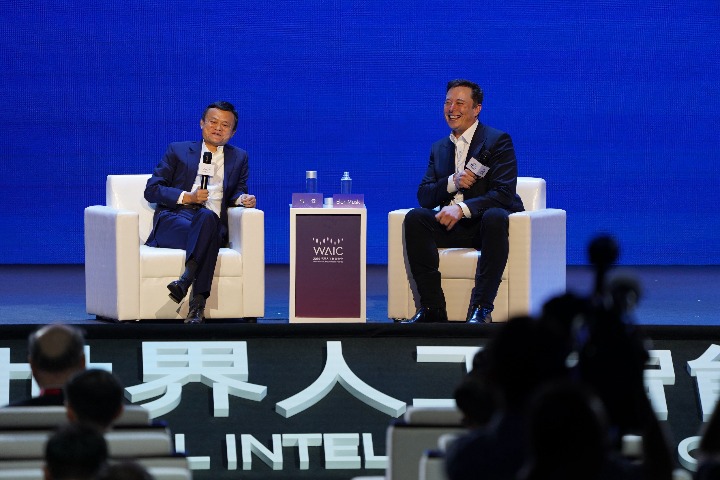
The 2019 World Artificial Intelligence Conference in Shanghai witnessed a landmark conversation between two of the most visionary entrepreneurs of our time: Jack Ma, founder of Alibaba Group, and Elon Musk, CEO of Tesla and SpaceX. The discussion ranged from the future of work and education to the sustainability of human civilization and the role of AI in shaping tomorrow. While both men acknowledged the transformative power of AI, their perspectives diverged sharply on its implications.
On Jobs: Optimism vs. Obsolescence
Jack Ma offered an optimistic view, arguing that every technological revolution initially sparks fear about job displacement but ultimately creates new opportunities. He predicted that within 20 to 30 years, people would live much longer and that the concept of a traditional full-time job would become obsolete. “People should work three days a week, four hours a day,” Ma suggested, because AI would free humans to focus on being happier and experiencing life. He emphasized that the jobs of the future would revolve around making people happy and caring for the elderly, tasks that require emotional intelligence and human touch. Ma also pointed out that as life expectancy rises to 120 years, birth rates may decline, leading to a need for AI-powered robots to care for an aging population.
Elon Musk countered with a more cautious stance. He argued that AI would progressively render human jobs pointless. “The last job that will remain will be writing software, but eventually AI will just write its own software,” he said. Musk stressed that people fundamentally enjoy interacting with others, so careers involving people skills, engineering, or arts might remain relevant. However, he warned that society must act quickly to adapt, as “we don’t have much time.” Musk’s perspective reflects his broader concerns about AI surpassing human capabilities and the need for proactive measures, such as neural interfaces, to keep pace.
This debate echoes longstanding discussions in economics and technology. Historical patterns, such as the Industrial Revolution, show that while jobs are displaced, new ones emerge. However, the speed and scale of AI-driven automation could be unprecedented. According to a 2019 McKinsey report, up to 800 million jobs worldwide could be automated by 2030. Yet, as Ma highlighted, new roles in caregiving, creative arts, and human experience could absorb much of the labor force. The key question is whether educational systems and social safety nets can adapt quickly enough. Experts also note that part-time or gig work may become more common, aligning with Ma’s vision of shorter workweeks. But Musk’s warning about the pace of change suggests that without reskilling initiatives, many workers could be left behind. The global conversation on universal basic income has gained traction as a possible solution, though neither Ma nor Musk explicitly endorsed it during their exchange.
On Education: Creativity vs. Computation
Education was another flashpoint. Ma criticized current education systems as being designed for the industrial age, focusing on memorization and calculation—tasks at which computers already excel. He advocated for a shift toward nurturing creativity, art, music, and dance, because these are inherently human activities that machines cannot replicate. “Computers only have chips, man has the heart. It’s the heart where wisdom comes from,” Ma said, emphasizing human uniqueness.
Musk strongly disagreed. He asserted that humans can create things smarter than themselves, pointing out that “computers are actually much smarter than human beings in so many dimensions.” He cited chess as an example: while it was once a measure of human intelligence, now a cellphone can beat the world champion. Musk warned that the biggest mistake smart people make is assuming their own superiority. He also echoed Ma’s concern about declining birth rates, predicting that “the biggest problem the world will face in 20 years is population collapse, not explosion.” This remark ties into long-term demographic trends, with many developed countries facing aging populations and low fertility rates. AI could exacerbate these trends by reducing the need for human labor and potentially altering social structures.
The educational implications are profound. If AI can outperform humans in cognitive tasks, traditional curricula focused on knowledge acquisition may become obsolete. Instead, skills like critical thinking, emotional intelligence, and adaptability will be paramount. Countries like Finland and Singapore have already begun integrating creativity and problem-solving into their school systems. The conversation between Ma and Musk underscores the urgency of rethinking education globally to prepare future generations for an AI-driven world. Moreover, the role of lifelong learning becomes critical, as workers may need to retrain multiple times over their extended lifespans. Ma’s emphasis on arts and humanities resonates with a growing movement to balance STEM education with soft skills, ensuring that humans retain their distinct value in an automated economy.
On Life and Sustainability: Earth vs. Space
Turning to broader existential issues, Musk expressed optimism that humans will solve environmental sustainability, though not without tremendous effort. He praised China’s leadership in electric vehicles, noting that half of all electric cars sold in the previous year were made in China. He also touched on the possibility of solving biological aging through DNA changes, but questioned whether society would accept such modifications. Musk’s vision extends to space colonization, a core part of his long-term strategy to safeguard humanity from potential catastrophes on Earth.
Ma responded by emphasizing that AI can definitely help environmental sustainability, but he stressed that humanity should focus on improving life on Earth rather than escaping to space. “Going to space is great, but spending resources on picking up garbage from the ocean is more difficult,” Ma said. He argued that AI can assist in cleaning up pollution and managing resources. More importantly, he shifted the focus from longevity to happiness: “Human beings can live better and longer, but what we need is not to live longer, but live healthier.” Ma concluded that technology alone does not change the world; it is the dreams behind technology that matter.
This exchange highlights two competing visions of humanity’s future. Musk’s space ambitions, embodied by SpaceX’s mission to colonize Mars, reflect a contingency plan if Earth becomes uninhabitable. In contrast, Ma’s Earth-first approach aligns with the Sustainable Development Goals, emphasizing conservation and equitable progress. Both perspectives have merit: space exploration drives innovation and provides a backup, while environmental stewardship is essential for current populations. AI can serve both ends, from optimizing energy grids to modeling climate scenarios. The debate also touches on ethical questions about genetic engineering and the definition of a good life. As AI and biotechnology converge, societies will need to deliberate on what it means to be human, and whether longer lifespans should be pursued without corresponding improvements in well-being.
Beyond the main discussion, the two entrepreneurs shared lighter moments, with Musk praising China’s progress in AI and Ma joking about his own technical limitations. The event drew a packed audience of researchers, business leaders, and policymakers, reflecting global interest in AI’s trajectory. Both men have since continued to influence AI discourse: Ma has focused on philanthropic education initiatives, while Musk has advanced neuralink and warned about AI risks through his involvement in organizations like OpenAI. The Shanghai conversation remains a touchstone for understanding the optimistic and cautionary narratives that shape our approach to artificial intelligence.
Source: Global News