

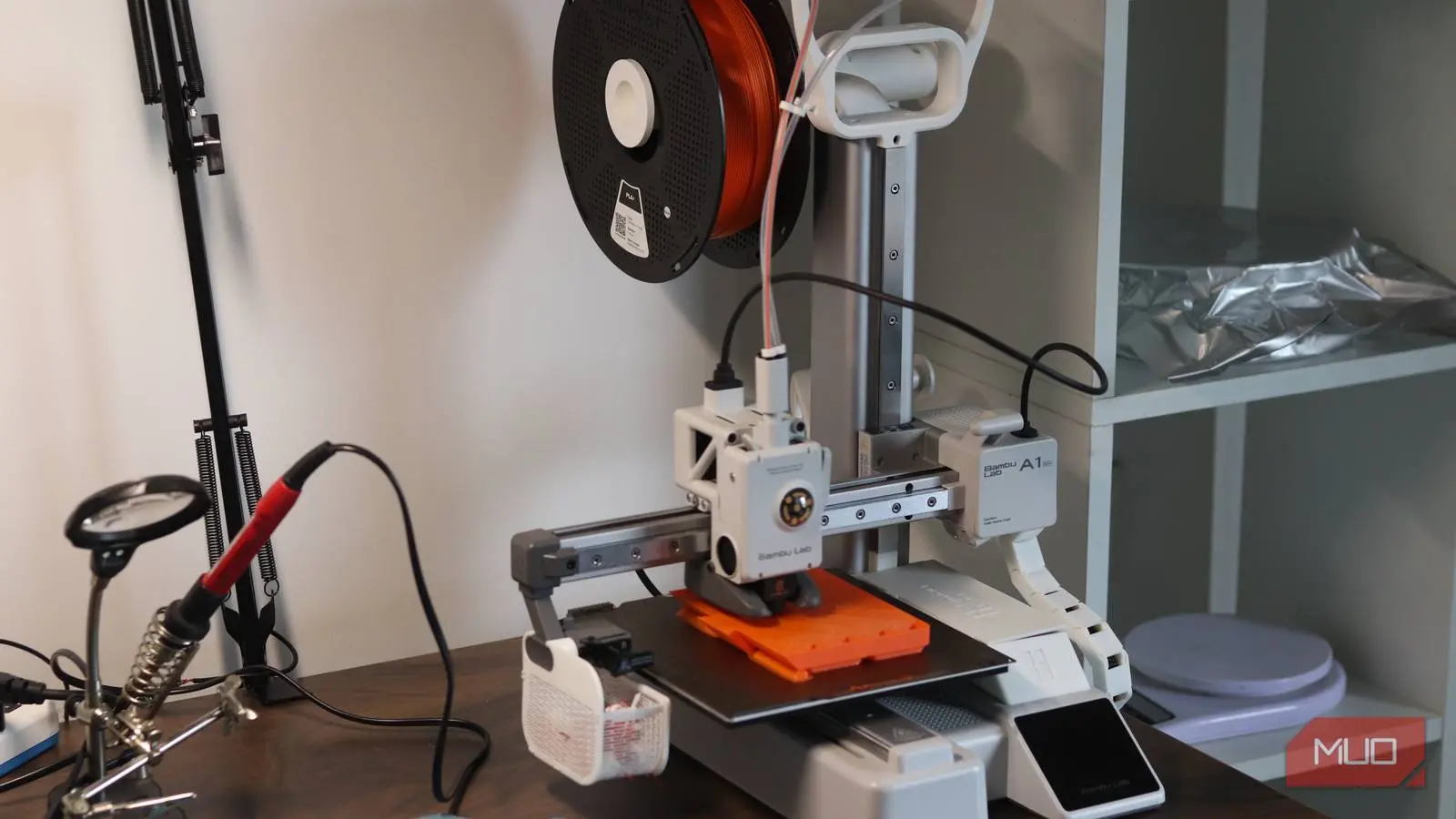
For nearly a decade, I told myself that 3D printers were too noisy, too slow, too demanding, and too messy for a normal home office. I had good reasons for believing that, at least based on my first experience with the technology back in 2017. When I finally bought a modern printer in 2026, I discovered that I was wrong about almost everything. The machine I had built up in my head as a temperamental hobbyist tool turned out to be a quiet, reliable, and genuinely useful home appliance.
Key facts
- The author maintained two 3D printers in 2017 at a first job out of high school.
- That early experience created a decade-long hesitation to buy a personal 3D printer.
- The author bought a Bambu Lab A1 Mini in 2026.
- Most fears about noise, speed, and maintenance proved outdated.
- The printer logged 134 hours of total print time with very little intervention.
- The biggest regret was waiting so long instead of buying sooner.
The printer was never the problem
I overestimated the noise, space, and disruption a 3D printer would bring
My first job out of high school involved repairing and maintaining two 3D printers. The model I worked with most was the Wanhao Duplicator 3, a heavy, almost industrial machine with a large enclosure but a surprisingly small print bed. Every print started the same way: slice the file on a PC, copy it to a microSD card, carry the card to the printer, and hope the paper-based bed leveling was accurate enough. More often than not, it was not acceptably accurate. The machine also made a lot of noise, which made it feel like something that belonged in a workshop rather than a home office.
That experience stayed with me. When I started thinking about buying a 3D printer for myself, I pictured another bulky machine sitting on my electronics workbench, humming and whirring all day. My workbench is right next to my main desk, so I worried the sound would be a constant distraction. I also worried that a large printer would take up valuable space and turn my organized bench into a mess of spools and cables.
Those assumptions disappeared within the first hour of using a Bambu Lab A1 Mini. The printer has a tiny footprint and looks more like a modern consumer device than a piece of industrial equipment. The motors are almost silent. Aside from the cooling fan, I can barely hear it running. I now run print jobs for hours while working less than a meter away, and the background noise is close to zero. The physical footprint is also far less intrusive than I expected. A single compact unit and a small filament spool are all it takes to get started.
Speed mattered less than I expected
Long print times stopped feeling important once the printer could work unattended
My fear about time had two layers. The first was print speed. I associated 3D printers with glacial progress that produced a small part only after most of a day. The A1 Mini changed that immediately. A standard Benchy test boat prints in about 20 minutes at default settings. For practical prints like brackets, enclosures, organizers, and replacement parts, the time savings are even more noticeable. Components that older machines would have taken hours to produce are done in a fraction of that time.
The second layer was the amount of attention a print required from me. I remembered watching prints fail because the first layer did not stick, the nozzle clogged, or the filament ran out in the middle of the night. Modern printers handle almost all of that automatically. The A1 Mini levels its own bed before every print. Filament runout detection pauses the job when the spool runs dry. A built-in camera lets me check progress from my phone through the Bambu Handy app. If I take the time to set the printer up in Home Assistant, I can even see the status on my smart home dashboard.
This combination of speed and automation changed how I use the printer. I have started prints while I was hundreds of kilometers away and returned home to find a finished part waiting on the build plate. As long as the printer is calibrated and the filament is tuned, 3D printing becomes a background process instead of a time-consuming hobby. That was a huge shift from the days when a print required me to sit nearby and constantly watch for failures.
Maintenance turned out to be mostly a myth
Modern printers require far less tinkering than their reputation suggests
I also expected maintenance to eat into my schedule. With the old Wanhao, I considered myself lucky if I made it through a day without unclogging a nozzle or releveling the bed. Belt tension checks, nozzle swaps, and calibration prints were part of the routine. I mentally budgeted for all of that when I bought the A1 Mini. It turned out to be unnecessary.
In the 134 hours of total printing time since I got the printer, all I have done is calibrate my filament profile once. Even that was optional. The generic PLA profiles worked perfectly well with filament from several different brands. I have not had to unclog a nozzle, adjust a belt, or manually level the bed. The machine simply works. Basic maintenance such as cleaning the build plate and lubricating the rails is all it asks for.
There is one area where I would temper expectations, and that is multi-color printing. I did not buy the AMS Lite because of the waste it produces. Multi-color prints use significantly more filament and take much longer because the printer has to purge the previous color before switching. For my everyday prints, which are mostly functional parts like ESP32 enclosures, mounts, cosmetic pieces, and replacement brackets, the standard single-color setup is more than enough. It is remarkably low friction compared to the experience I remembered.
What changed in a decade
The gap between the 3D printers of 2017 and the models available in 2026 is enormous. The original printers were heavily dependent on user skill. Bed leveling was manual, slicing software was clunky, and troubleshooting required a deep understanding of mechanics and firmware. Much of the time, getting a good print meant chasing a problem through forums and trial and error.
Modern machines have shifted that burden to hardware and software. Automatic bed leveling is now standard on most consumer models. Sensors detect filament runout, clogged nozzles, and even first-layer adhesion issues. On-board software often handles calibration steps that used to be manual rituals. Many printers now connect to Wi-Fi and can be monitored with an app, which means you do not have to stand next to the machine to know what is happening.
Print speeds have also improved because of better kinematics, lighter print heads, and more precise control systems. The result is a device that asks far less from its user while producing better output. For someone like me, carrying around a decade-old impression of the technology, the difference was shocking.
The biggest mistake was waiting so long
I should have bought a 3D printer years earlier instead of overthinking it
The realization that hurt most was that my hesitation was based on an old mental model. I kept imagining what 3D printing was like in 2017 rather than what it had become by 2026. Modern printers from Bambu Lab, Creality, Elegoo, and Prusa behave less like hobbyist kits and more like reliable home appliances. You configure the machine once, make a few adjustments to the defaults or trust them entirely, and it works. It does not demand full days of maintenance, and it does not fail unexpectedly every other print.
I bought my printer before the industry started pulling some of the more aggressive commercial tactics, but the hardware itself is outstanding. The A1 Mini is not a niche product for tinkerers; it is a tool for anyone who wants to turn ideas into physical objects. The software experience is just as important as the mechanics. Mobile apps, cloud monitoring, and automatic calibration have removed almost every barrier that used to keep casual users away.
If your hesitation is about time, both the time prints take and the time the machine demands from you, that concern has been addressed. Modern 3D printing is fast, reliable, and unobtrusive. It gets out of your way so you can work on other things while it operates. I wish I had stopped waiting much sooner.
Source: MakeUseOf News