

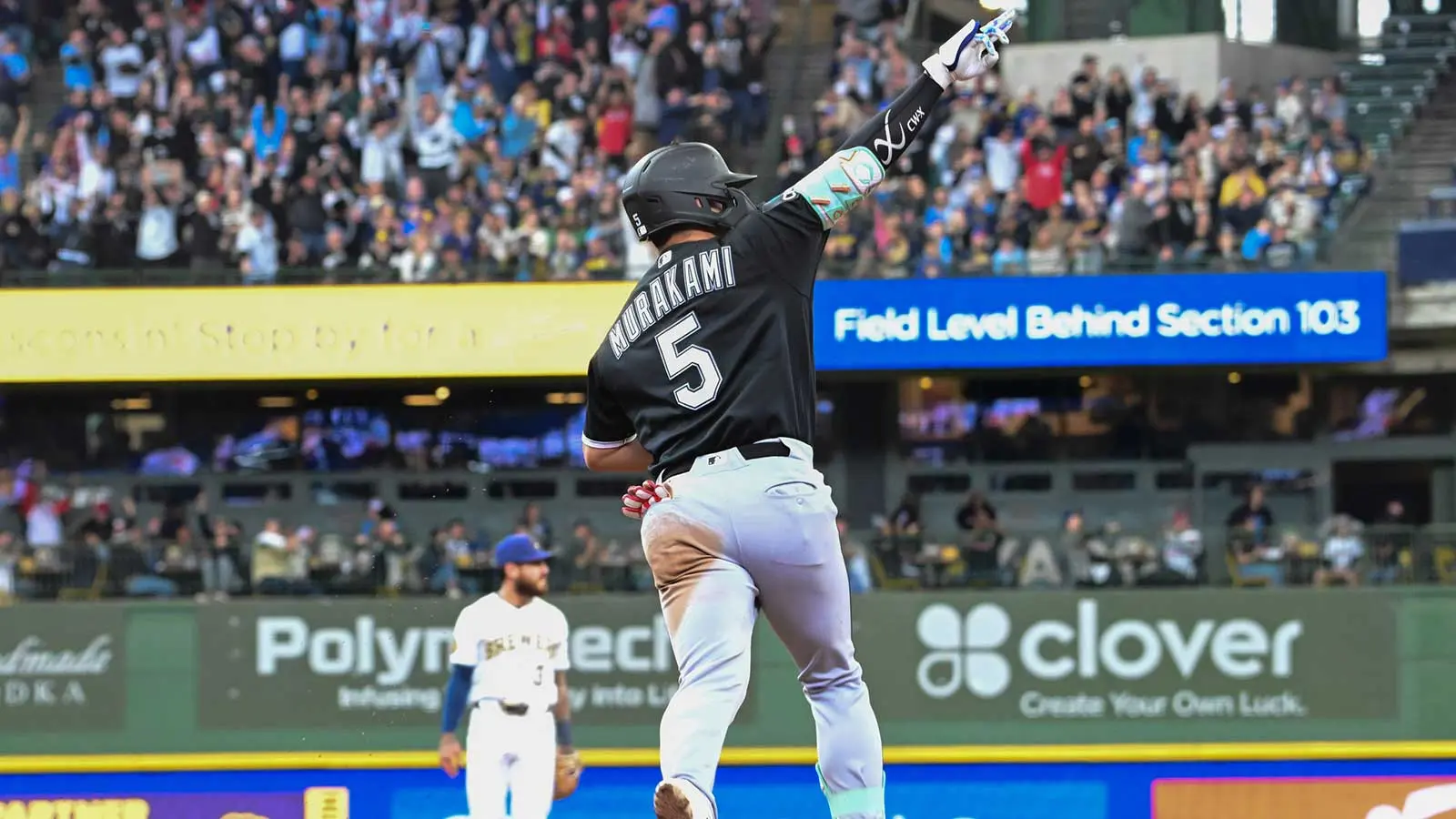
The 2026 MLB All-Star Week in Philadelphia provided a stage for both baseball excellence and unexpected human connections. For Chicago White Sox rookie Munetaka Murakami, his appearance on The Pat McAfee Show before the Home Run Derby became a viral moment that showcased his personality beyond the diamond. The conversation took an amusing turn when Murakami, trying to answer a question about his music preferences, began humming a familiar tune that instantly resonated with the host.
McAfee recognized the melody as Clarence Carter's bluesy classic 'Strokin',' a song that has become an unlikely anthem in certain circles. The two men ended up singing along together, with Murakami admitting he did not know the song's title but could recall the memorable refrain. The clip, later shared on social media, captured a genuine moment of cross-cultural bonding over a shared appreciation for old-school R&B.
Murakami's Journey to the Major Leagues
Munetaka Murakami's path to the Chicago White Sox was anything but ordinary. Before arriving in the United States, he established himself as one of the most prolific home run hitters in Japanese professional baseball history. Playing for the Tokyo Yakult Swallows in Nippon Professional Baseball (NPB), Murakami burst onto the scene as a teenager and quickly became a superstar. In 2022, he posted one of the greatest seasons in NPB history, batting .318 with 56 home runs and 134 RBIs, earning the Central League MVP award. His power display included a stretch where he homered in five consecutive at-bats, a feat that captivated the baseball world.
After several dominant seasons, Murakami exercised his posting rights and signed a multi-year contract with the White Sox during the 2024-2025 offseason. The deal was seen as a major coup for a franchise eager to add young, elite talent. Murakami's arrival in Chicago brought immense expectations, and he did not disappoint in his rookie campaign. Through his first 57 games before his injury, he slashed .285/.385/.553 with 20 home runs and 41 RBIs, showcasing the same elite plate discipline and raw power that made him a legend in Japan.
Overcoming a Hamstring Injury
Murakami's season was interrupted by a strained right hamstring that forced him to miss 35 games. The injury occurred while he was chasing a fly ball in right field, a rare misstep for a first baseman who had been remarkably durable throughout his career. The White Sox medical staff took a cautious approach, knowing that Murakami's long-term health was paramount. During his absence, the team struggled offensively, highlighting his importance to the lineup.
He returned just three days before the All-Star break, and his activation came at a crucial time. The White Sox were battling for positioning in the AL Central, and Murakami's presence provided a much-needed boost. In his first game back, he went 2-for-4 with a double, showing no lingering effects from the injury. The decision to include him in the Home Run Derby, despite his limited recent game action, was a testament to his raw power and the excitement he generated among fans.
The Pat McAfee Show Moment
The interview on The Pat McAfee Show was intended to be a standard pre-Derby promotional appearance, but it quickly turned into a memorable exchange. McAfee, known for his energetic and unpredictable style, asked Murakami about his pregame rituals and music preferences. Murakami, through a translator, attempted to describe a song he enjoys listening to before batting practice. He started humming the opening notes of 'Strokin',' and McAfee's face lit up with recognition.
The host immediately joined in, and the two sang the iconic chorus together, much to the delight of the studio audience. McAfee later posted the clip on X with the caption, 'I BE STROKIN'' PMSLive,' which quickly garnered millions of views. For Murakami, it was a chance to show a playful side that American audiences had not yet seen. The music connection humanized the slugger, who often appears focused and serious on the field.
This moment exemplifies how sports and pop culture can intersect in unexpected ways. Clarence Carter's 1985 hit, which gained renewed popularity through various media appearances, found new life through a Japanese baseball star and a former NFL punter turned media personality. It also highlighted Murakami's willingness to embrace American culture, a trait that has helped him adjust to life in Chicago.
Home Run Derby Performance
Later that evening, Murakami stepped into the batter's box at Citizens Bank Park for the 2026 Home Run Derby. The event featured a star-studded field, including Kyle Schwarber, Pete Alonso, and Julio Rodríguez. Murakami, seeded seventh, faced the pressure of performing on a national stage after a prolonged layoff.
In the opening round, he launched nine home runs, with his longest blast traveling 466 feet. His homers averaged 421 feet and an exit velocity of 110 mph, numbers that placed him near the top of the field in terms of raw power. The performance was enough to advance him past the first round but fell just short of moving on, as Schwarber edged him out with 10 homers. Nevertheless, Murakami became only the second Japanese-born player to participate in the Derby, following Shohei Ohtani's appearance in 2021.
His 466-foot shot was the second-longest of the entire round, trailing only a mammoth 472-foot blast from Giancarlo Stanton. Murakami's swing is a thing of beauty—a compact, powerful stroke that generates enormous bat speed through the zone. Scouts have compared his mechanics to a young Albert Pujols, with a similar ability to drive pitches to all fields.
The Significance of Murakami's Rookie Season
Murakami's debut season has been a bright spot for the White Sox, who have endured their share of struggles in recent years. His combination of power, on-base skills, and defensive competence at first base has made him an immediate fan favorite. Beyond the numbers, his demeanor has impressed teammates and coaches alike. He is known for his tireless work ethic, often arriving at the ballpark hours before games to study video and take extra batting practice.
The transition from NPB to MLB is often challenging, with differences in pitching quality, travel demands, and cultural adjustments. Murakami has handled it with remarkable poise. He credits veteran teammates like Luis Robert Jr. and Andrew Benintendi for helping him navigate the daily grind. His interpreter, who travels with him, has also been instrumental in bridging communication gaps.
From a statistical standpoint, Murakami's 20 home runs in 57 games project to a full-season pace of over 50, a figure that would put him in elite company. His .938 OPS ranks among the top ten in the American League, and his walk rate of 12% demonstrates advanced plate discipline. The White Sox have him under team control for several more seasons, making him a cornerstone of their rebuild.
Broader Context: Japanese Players in MLB
Murakami's success is part of a larger trend of Japanese stars making an impact in Major League Baseball. Following in the footsteps of pioneers like Hideo Nomo and Ichiro Suzuki, and contemporaries like Shohei Ohtani and Yoshinobu Yamamoto, Murakami represents the next wave of talent from Japan. His personality and playing style have drawn comparisons to a mix of Ohtani's power and Hideki Matsui's approach at the plate.
The Home Run Derby appearance further cemented his status as a global baseball ambassador. Fans in Japan stayed up late to watch the event, and Murakami's performance was celebrated across social media platforms in both countries. The music moment with McAfee also resonated internationally, showing that baseball players can connect with fans through unexpected channels.
Critics have sometimes questioned whether Japanese players can sustain success in MLB, but Murakami's early performance suggests he will be a force for years to come. His ability to adjust to different pitchers, handle the pressure of big moments, and integrate into a new culture bodes well for his future.
White Sox Outlook and Murakami's Role
The White Sox entered the 2026 season with a mix of veterans and emerging young talent. While the team's playoff hopes remain alive, they have faced inconsistency in both starting pitching and lineup depth. Murakami's return from injury provides a stabilizing presence in the middle of the order. He typically hits third or fourth, protecting teammates like Yoán Moncada and generating runs with his power.
Manager Pedro Grifol has praised Murakami's professionalism and adaptability. In a press conference following the All-Star break, Grifol noted that Murakami's work habits have set a standard for the entire roster. The coaching staff has also worked with him on footwork at first base, where he has shown steady improvement throughout the year.
The trade deadline looms in a few weeks, and the White Sox front office faces decisions about whether to buy, sell, or stand pat. Regardless of the direction, Murakami is considered untouchable—a centerpiece around which the franchise can build. His contract is team-friendly, giving Chicago financial flexibility to add pieces in free agency.
A Lasting Impression from All-Star Week
Though Murakami did not win the Home Run Derby, his participation and the accompanying media moments left a lasting impression. He showed that he can compete with the best power hitters in the game, even after a significant injury layoff. The music connection with Pat McAfee also endeared him to a broader audience, transcending typical sports coverage.
As the second half of the season begins, Murakami will look to build on his strong start. The White Sox have a challenging schedule ahead, including critical series against division rivals Cleveland and Minnesota. If Murakami can stay healthy, he has the potential to lead Chicago to a postseason berth and perhaps even capture Rookie of the Year honors.
In the end, the story of Munetaka Murakami is still being written. The slugger, the song, and the shared laugh on national television offered a glimpse into a player who is as comfortable under the spotlight as he is in the batter's box. The baseball world will be watching closely to see what he does next.
Source: ClutchPoints News