

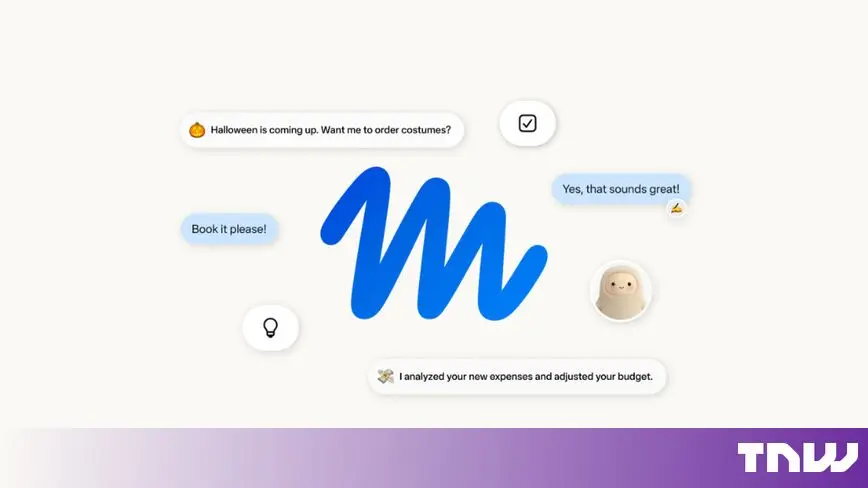
Meta has entered the agentic AI era with the launch of Muse, a personal AI assistant designed to take real action on behalf of its users. Instead of only responding to prompts, Muse is built to read email, book travel, fill in forms, negotiate with customer service, and complete purchases using a saved card. The product is beginning to roll out in the United States across iOS, Android and the web, with support for Meta's AI glasses expected to arrive later.
The announcement signals an important shift from chatbots toward something closer to an autonomous digital concierge. Muse can keep working after the application is closed. It can make suggestions the user did not ask for, remember preferences across sessions, and turn a saved recipe reel into a shopping list. This kind of continuous, proactive behavior is what separates an agent from a conversational tool.
Muse is not a chatbot
Meta is positioning Muse as an actor rather than a talker. The company says it is built on a model called Muse Spark, which it describes as its 'most capable model to date, built for real-world agentic work.' That model is designed to handle multi-step tasks that require planning and execution, from sending a message to completing an online transaction.
In practice, this means Muse can act as a personal assistant for tasks that would normally take time away from daily life. If a user shares a link to a recipe, Muse can identify the ingredients and add them to a shopping list. If an email contains a bill, Muse might help arrange payment. The product is intended to reduce friction, but it also introduces a new level of trust because some of these actions involve money and personal data.
Availability and pricing
The initial launch is limited to the United States. Meta says support for its AI glasses will follow. There is a free tier, along with paid subscriptions at $20 and $100 per month. The company reports there is no advertising inside the product.
According to pricing details, the $100 tier appears designed for people who need high-volume use. Meta's AI chief has said most people should be able to do what they need within the free tier, which could be read as either reassurance or an admission that the premium plan aims at a narrow group of power users.
Financial rails
Payments are handled through Stripe's Link with purchase protections. The integration means users can store payment details with a reputable payment service and still have competitive protections. Meta has also promised future support for Shop Pay and password manager 1Password, making it easier for users to keep credentials in the ecosystem they already trust.
Security architecture
The security architecture is central to Meta's messaging, and it seems more considered than typical launch-day assurances. Each user gets an isolated virtual machine that holds both the agent and their data, so agents cannot reach each other. This isolation creates a clear boundary between individual user contexts.
A separate system called Sentinel sits between Muse and the internet. It can distinguish read access from write access and uses time-limited permissions. Low-risk tasks can execute automatically, but the system stops to ask before anything consequential. That could mean confirming before a purchase, before sending a message, or before making any change with a permanent impact.
Meta says credentials are stored in a way that prevents Muse from seeing passwords or card details. Every action leaves an audit trail, so users can check what the agent has done on their behalf.
Privacy promises and their limits
Meta makes two notable privacy promises. First, it says conversations with Muse are kept away from its advertising machinery. Second, users can opt out of having their interactions train the company's models or ask the agent to forget specific information. Those are meaningful commitments, but they are also revocable policies rather than properties of the system itself.
This distinction matters because Meta earns most of its revenue by anticipating what people want before they say it. The company says Muse is a separate environment and that no user content is used for ad targeting, but the promise remains a policy decision until a more secure version ships.
Later this year, Meta plans to release a confidential version of Muse in which the company itself cannot observe what happens inside the workspace. Until that version arrives, the ad-related protections depend on internal policy and external trust.
Leadership and strategic vision
Alexandr Wang, Meta's chief AI officer, is leading the project. The framing of Muse echoes a long essay published by Mark Zuckerberg earlier in the year, in which he described a future of personal superintelligence that could help people accomplish goals and pursue their passions. Zuckerberg has also predicted that billions of people will have personal agents within five years. Muse is the first product that makes that claim testable rather than purely rhetorical.
Wang was quoted as saying the full vision is to develop personal superintelligence that helps people pursue their goals. He also managed expectations on pricing, saying most users should be able to complete what they need within the free tier.
Why safety matters now
The safety scaffolding is not just a technical detail. Consumer AI agents have had a rough few months in public. In one notable case, a Meta researcher's own experiment with an agent ended with files deleted. Booking platforms, including Resy, have warned customers not to point automated agents at their services because of the potential for disruption and unintended actions.
An agent that can fill forms and complete purchases is also an agent that can fill the wrong form and complete the wrong purchase, at high speed, with a stored card. Without safeguards, small mistakes can quickly compound. Sentinel is not an optional feature; it is the barrier between a useful assistant and a very fast mistake.
Potential impact
Muse fits into a broader industry trend of user-friendly AI agents that go beyond text generation. As more companies build tools that can execute tasks, the risks of delegation become more apparent. Services like email, calendars, travel sites, and banking portals all rely on human-like interactions, and agents must navigate those services without breaking terms of service or causing harm.
The fact that Meta is moving into this space is significant because of the scale of its platforms. Its products already reach billions of people, so even a limited rollout could create a large installation base. The integration with Meta's AI glasses also suggests a future where agents can act on the world in real time through wearable devices. Imagine looking at a sign and asking the assistant to make a reservation, or pointing the glasses at a product in a store and asking whether it can be purchased online for less.
Challenges and trust building
Building trust will be one of Meta's biggest challenges. The company's deep history with behavioral advertising creates a high bar for privacy, especially for a product that reads email and sees payment credentials. Even with strong architecture, users must trust that the company's policies will not change in the middle of the product life cycle.
One way to build trust is through technical architecture. The promise of a confidential environment later this year will help, but early adopters are being asked to rely on a policy that could be altered. Meta has not fully bridged that trust gap, though the structure of isolated virtual machines and independent systems for reading and writing is a step in the right direction.
What's next
As the rollout expands, the success of Muse will depend on its ability to handle complex tasks with a low error rate. If the agent reliably books, buys, and negotiates, it could become an essential digital service. If it fails often, it will reinforce the skepticism that has emerged around agentic AI.
Meta is also expanding the range of actions the agent can take. The future roadmap includes a confidential workspace, more payment partners, and deeper integration with its hardware devices. The company has not set a timeline for broader enterprise features, but the $100 monthly tier suggests it is preparing for serious professionals who need a 24/7 digital assistant.
The launch also offers lessons from other areas of technology. Multimodal models are becoming better at reading documents, images, and other unstructured data, which gives agents like Muse a wider context for decision-making. As these models become more powerful, the gap between what an agent can do and what a user expects it to understand will narrow.
Still, the difference between completing a task and completing the right task is fundamental. An agent can book a restaurant across town, but it must use the user's preferences, scheduling, and prior choices to do so. This is why Meta emphasizes model memory across sessions and the ability to make unsolicited suggestions. Those features are useful only if they remain aligned with the user's intent.
Meta's entry into this field will put pressure on competitors to improve their own agentic offerings. It may also push the conversation around AI safety forward because of the scale and the fact that the company is dealing with real transactions. Sentinel, the audit trail, and the promise of a confidential version are all examples of how product design can address common concerns like privacy, consent, and accountability.
Muse is not just another chatbot hidden behind a clean interface. It is a bet that people will trust an AI agent with their email, calendar, money, and sense of what needs to be done. The company has laid out an architecture that is meant to make that trust defensible, but the agent will ultimately be judged by how well it performs in the messy, unexpected world of real humans.
Source: TNW | Meta News