

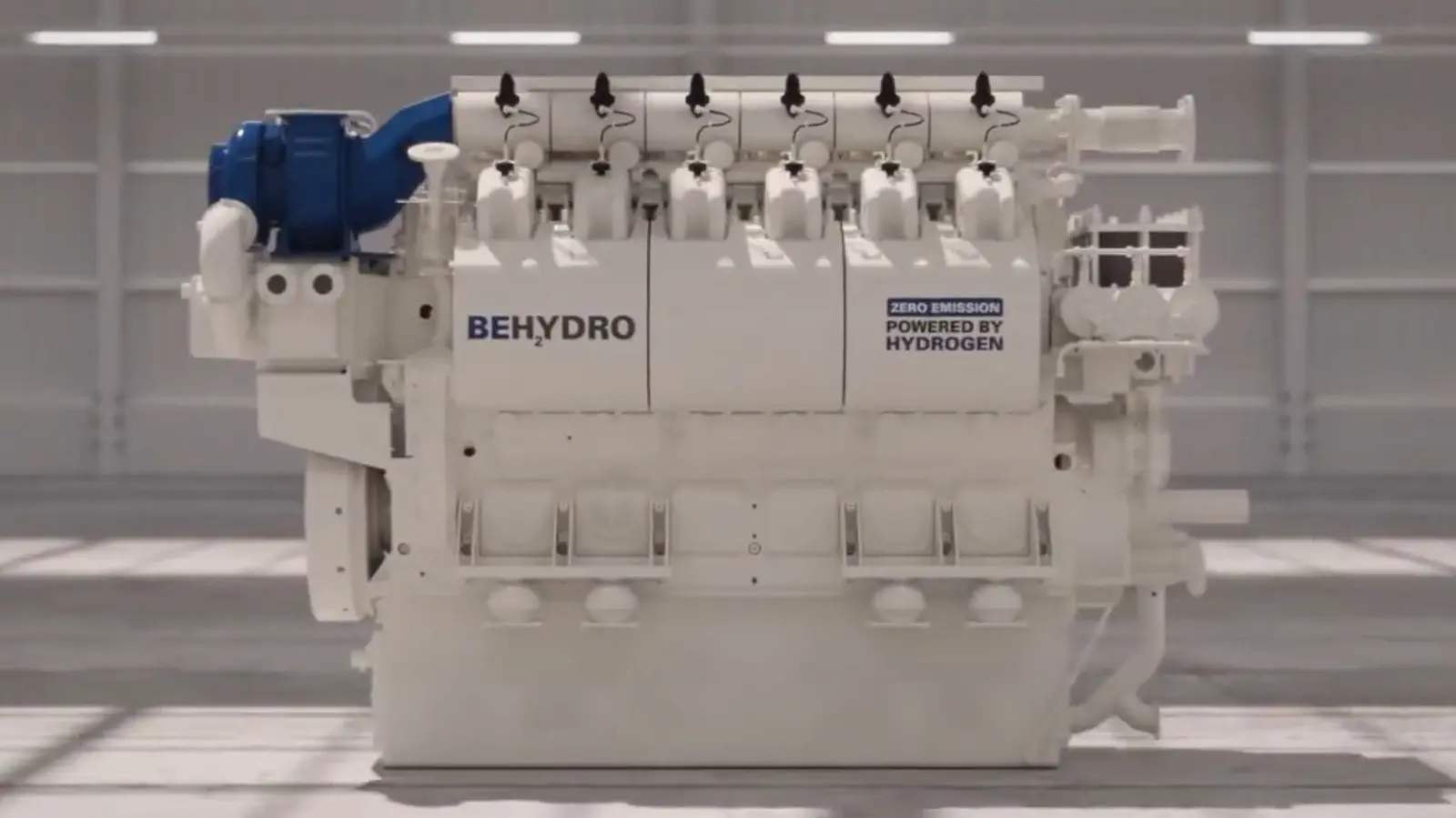
For over a century, gas and diesel combustion engines have dominated the transportation and industrial sectors. However, the quest for cleaner energy sources has never been more urgent. Alternative fuel engines, including those powered by hydrogen, have existed since the 1800s, but their widespread adoption has been slow. In recent years, hydrogen-powered automotive engines have garnered attention, yet the technology has yet to achieve mass market penetration in cars. Nonetheless, significant advances are being made in other domains, particularly in marine engineering. The world's first 100% hydrogen marine engine, developed by BeHydro—a joint venture between the Anglo Belgian Corporation (ABC) and Compagnie Maritime Belge (CMB)—has reached a historic point on its journey to becoming a commercial reality.
Lloyd's Register, one of the world's leading marine classification societies, has awarded BeHydro's all-hydrogen, spark-ignited marine engine a Type Approval Certificate. This certification confirms that the engine meets rigorous safety, performance, and reliability standards required for use in marine environments. In essence, the engine is now deemed ready for safe deployment on water as an alternative power source for industrial shipping. This achievement is particularly remarkable because BeHydro's engine runs solely on hydrogen, unlike hybrid systems that require a secondary fuel like diesel as a combustion catalyst. By eliminating the need for a pilot fuel, the engine produces zero carbon emissions during operation, emitting only water vapor and air.
The Historical Context of Hydrogen Engines
The concept of using hydrogen as a fuel is not new. The first internal combustion engine to run on a hydrogen-air mixture was built by François Isaac de Rivaz in 1808. Throughout the 19th and 20th centuries, hydrogen was occasionally used in engines, but the dominance of petroleum-based fuels limited its development. In the 1970s, the oil crises reignited interest in alternative fuels, and hydrogen gained attention as a clean energy carrier. However, the challenges of production, storage, and distribution hindered progress. Today, with growing concerns about climate change and emissions regulations tightening globally, hydrogen is once again being explored as a key component of the energy transition. The maritime sector, which accounts for nearly 3% of global greenhouse gas emissions, is under increasing pressure to decarbonize. The International Maritime Organization (IMO) has set ambitious targets to reduce emissions by at least 50% by 2050 compared to 2008 levels. Hydrogen-powered engines offer a promising pathway toward meeting these goals.
BeHydro and the Partnership Behind the Engine
BeHydro was established as a joint venture between ABC, a Belgian manufacturer of medium-speed diesel and gas engines with over a century of experience, and CMB, a major shipping company. The collaboration leverages ABC's expertise in engine design and CMB's practical knowledge of marine operations. The result is a hydrogen engine platform that can deliver between 1,000 and 2,670 kilowatts of power, depending on the variant. This range makes it suitable for use as a primary propulsion engine for smaller vessels or as an auxiliary power unit for larger ships. The engine's spark-ignition system is specifically designed for hydrogen's unique combustion properties, including its wide flammability range and high flame speed. The Type Approval Certificate from Lloyd's Register is a culmination of years of design, testing, and validation, including endurance tests and safety assessments. The certification process involved rigorous checks of the engine's fuel system, control systems, and fail-safe mechanisms to ensure safe operation in harsh marine environments.
Benefits of Hydrogen Combustion Engines
The primary advantage of hydrogen as a fuel is its clean combustion. When burned in air, hydrogen reacts with oxygen to form water vapor and trace amounts of nitrogen oxides (NOx). Unlike diesel engines, hydrogen engines produce no carbon dioxide, carbon monoxide, hydrocarbons, or particulate matter. This can dramatically improve air quality in ports and coastal areas, which are often heavily polluted by ship emissions. Additionally, hydrogen engines can achieve high thermal efficiencies. Recent research has demonstrated hydrogen engine designs with efficiencies comparable to diesel engines—up to 60% in some cases. This efficiency, combined with zero carbon emissions, positions hydrogen as a compelling solution for decarbonizing shipping. Moreover, hydrogen can be produced from renewable sources through electrolysis, creating a fully sustainable fuel cycle known as green hydrogen. When used in marine engines, green hydrogen enables near-zero lifecycle emissions.
Challenges and Remaining Hurdles
Despite the promise, several obstacles must be overcome for hydrogen to become mainstream in maritime applications. One of the most significant challenges is the lack of refueling infrastructure. Marine ports worldwide are not equipped with hydrogen bunkering facilities, and building such infrastructure requires substantial investment. The distribution network for hydrogen is also underdeveloped compared to the established supply chains for heavy fuel oil and marine diesel. Another issue is hydrogen's low energy density by volume. At ambient temperature and pressure, hydrogen gas occupies a large volume for the same energy content as fossil fuels. To be practical for ships, hydrogen must be either compressed to high pressures (350-700 bar) or liquefied at cryogenic temperatures (-253°C). Both methods require specialized storage tanks and handling systems, which can take up valuable space on vessels and add weight. Furthermore, hydrogen can embrittle certain metals, posing material selection challenges for engine components and fuel systems. Safety concerns also exist due to hydrogen's wide flammability range and low ignition energy. However, Lloyd's Register's Type Approval indicates that these risks have been adequately addressed for the BeHydro engine design.
Comparison with Other Low-Emission Technologies
Hydrogen combustion engines are just one of several low-emission technologies being explored for shipping. Battery-electric propulsion is suitable for short-sea routes and ferries but faces range and weight limitations for ocean-going vessels. Ammonia and methanol are being considered as alternative marine fuels, but they produce emissions—ammonia combustion can release nitrogen oxides and nitrous oxide (a potent greenhouse gas), while methanol still contains carbon. Hydrogen fuel cells, which convert hydrogen directly into electricity, offer higher efficiency than combustion engines but are currently more expensive and less durable. Hydrogen combustion engines represent a middle ground: they leverage existing internal combustion engine manufacturing capabilities and provide a familiar reliability profile, which can accelerate adoption. The BeHydro engine, with its spark-ignition design, is optimized for hydrogen's properties and avoids the need for complex fuel cell systems.
Future Prospects and Real-World Testing
With the Type Approval Certificate in hand, BeHydro is poised to begin real-world trials. The company has announced plans to install the engine on a vessel operated by CMB, which will serve as a demonstrator. This will allow engineers to gather data on performance, reliability, and maintenance requirements under actual operating conditions. The results will inform further refinements and help build confidence among shipowners, regulators, and financiers. Meanwhile, other companies are also developing hydrogen marine engines. For instance, MAN Energy Solutions and Wärtsilä have been testing hydrogen dual-fuel engines, while Cummins is working on hydrogen fuel cell modules for marine use. The race to commercialize hydrogen propulsion is accelerating, driven by stricter emissions regulations and corporate net-zero commitments. The IMO is also considering a carbon levy on shipping emissions, which would further incentivize the transition to low-carbon fuels. If hydrogen infrastructure can be developed in parallel with engine deployment, the maritime industry could see a significant shift toward hydrogen propulsion in the next decade.
The BeHydro achievement is an important step forward, but it is not the end of the journey. Scaling up hydrogen production, especially green hydrogen, remains a challenge. Current global hydrogen production is dominated by steam methane reforming, which emits carbon dioxide. Electrolysis using renewable electricity is cleaner but more expensive and accounts for only a small fraction of total production. Governments and industry are investing in hydrogen hubs and pilot projects, but large-scale availability of green hydrogen for shipping is likely at least a decade away. Nevertheless, the engine's certification demonstrates that the technology is technically ready; now the focus must shift to creating an ecosystem that supports its use. As hydrogen becomes more accessible, engines like BeHydro's could become a common sight on the world's oceans, helping to reduce the environmental footprint of global trade. The journey from a proof-of-concept to a commercially viable product is often long, but each regulatory milestone brings it closer to reality.
Source: SlashGear News