

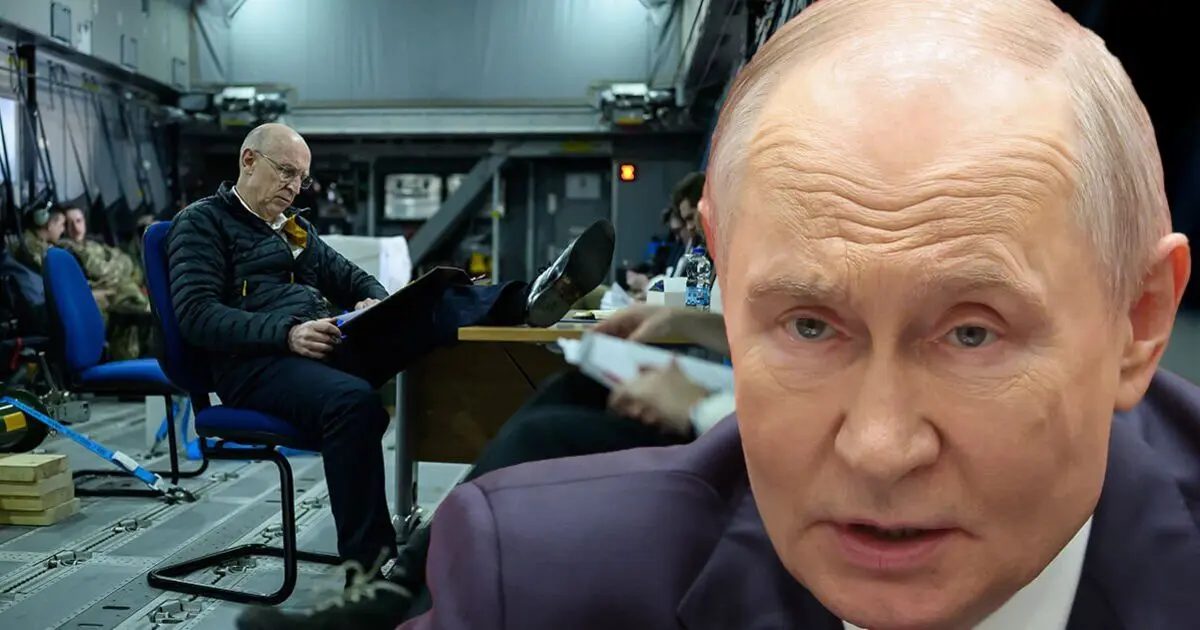
Last month, Defence Secretary John Healey stood in number 11 Downing Street and issued a direct message to Vladimir Putin. Standing before journalists as he revealed a month-long Royal Navy mission to track and deter Russian submarines, he told the Russian leader directly: “We see your activity over our cables and our pipelines, and you should know that any attempt to damage them will not be tolerated and will have serious consequences.”
Last week, Vladimir Putin sent a message back to Mr Healey, in the form of an electronic warfare attack on the defence secretary’s plane. The two interactions show the vastly different approaches towards the conflict boiling below the surface. Mr Healey used words, while Putin used actions. And, in the arena of global politics, as much as any other, actions speak louder than words.
The issue is, of course, that years of underinvestment in defence and two years of dithering on spending by the Labour government have largely put actions out of the reach of decision makers grasping for an ability to counter Russia’s ever increasingly brazen attacks, incursions and provocations.
The Defence Investment Plan is wildly behind schedule, and each passing month that the publication is delayed is more time that military planners spend with their arms tied behind their backs.
Conversations with people inside the MOD and the British Army would suggest that the delay lies not entirely with defence but with the Treasury, who have seemingly lost faith in the MOD’s ability to get maximum value for each taxpayer pound. History would suggest those concerns are not without merit, but history would also suggest that to wait, dither and delay while your adversaries arm and prepare is highly risky if not outright negligent.
The fact of the matter is that while John Healey calls for more funding and Rachel Reeves drags her heels in pursuit of supporting the lie-ins of those work-shy in our society, one man could step in to drive Britain’s rearmament: Sir Keir Starmer.
It is well known that the prime minister does not care much for adjudicating on the inter-departmental squabbles of cabinet ministers. But in this case, Sir Keir, what is the alternative? Another two years of incremental progress while Russia devotes its entire national effort towards war? The reality in geopolitics is that if you are not moving forward, you are going backwards. Under Starmer, this Government has hesitated at every moment to drive rearmament forwards to the extent where defence small and medium enterprises are looking abroad for business, such is the frustration with the lack of appetite in the UK market.
War in the Middle East, Iranian-backed attacks on RAF bases, Russian drones in Poland and Estonia, Moscow-backed vigilantes launching attacks on the UK mainland. None of these has lit a spark under this government and forced them to speed up their action. You would like to think that a brazen and deliberate attack on the Defence Secretary would do so, but recent history suggests it won't.
To understand the gravity of the situation, we must look at the broader context of Russian aggression. Since the full-scale invasion of Ukraine in 2022, Moscow has systematically tested NATO’s resolve. The attack on Mr Healey’s plane is not an isolated incident but part of a pattern. In recent months, Russian aircraft have violated Baltic airspace, submarines have been detected near undersea cables, and cyber attacks have targeted critical infrastructure. The UK, as a leading NATO member, has a responsibility to respond with both strength and speed.
Yet the Labour government’s record on defence is mixed. While they have committed to increasing spending to 2.5% of GDP, the timeline remains vague. The Treasury’s insistence on efficiency reviews before releasing funds has created a bureaucratic bottleneck. Meanwhile, Russia’s defence budget has soared, with Putin prioritising military production over social welfare. The asymmetry is stark.
Former military chiefs have repeatedly warned that the British Army is at its smallest size since the Napoleonic Wars. The Royal Navy faces shortages of frigates and destroyers, and the RAF’s Typhoon fleet is ageing. The electronic warfare attack on the Defence Secretary’s plane is a humiliating reminder that even the most senior officials are not immune to Russian technological warfare. GPS jamming and spoofing have become routine tools for Moscow, used to disrupt civilian aviation and military operations alike.
John Healey has called for a “whole-of-nation” approach to defence, but words alone cannot deter a Kremlin that respects only power. The Defence Investment Plan, originally promised for the summer, has now been postponed to the autumn. Each delay emboldens Putin, who sees hesitation as weakness.
Keir Starmer must use his authority to resolve the deadlock between the MOD and the Treasury. He has already shown willingness to take tough decisions on fiscal policy, but defence has not been a priority. The prime minister’s background as a lawyer and human rights advocate may make him instinctively cautious about military spending, but the world has changed. The UK cannot afford a prime minister who avoids adjudicating between ministers when the security of the nation is at stake.
Moreover, the attack on the Defence Secretary is a direct challenge to British sovereignty. If a Russian electronic warfare attack can jam a government plane, what stops them from targeting civilian aircraft or critical communication networks? The UK must invest in counter-electronics capabilities, hardened GPS systems, and more robust cybersecurity. These require immediate funding, not a multi-year review.
In addition, the UK must rebuild its defence industrial base. Small and medium enterprises, which are the backbone of innovation in defence technology, are fleeing to markets like the US and Israel because of red tape and slow procurement processes. Starmer could accelerate the pace by personally chairing a new defence industrial council, cutting through bureaucracy and ensuring orders are placed quickly.
The geopolitical environment is deteriorating at a pace that the government has not matched. The war in Ukraine grinds on, with no end in sight. Iran’s proxies continue to target Western forces. China is expanding its military footprint. In this volatile landscape, the UK cannot afford to be seen as a paper tiger. Putin’s attack on Healey is a deliberate provocation, designed to test whether Britain has the will to respond. If the only response is a sternly worded statement, the message to Moscow will be clear: the UK is weak.
Sir Keir Starmer has the opportunity to change that narrative. He can show leadership by intervening in the Treasury-MOD standoff, setting a firm deadline for the Defence Investment Plan, and announcing immediate extra spending for counter-electronic warfare measures. He can also use his upcoming meetings with NATO allies to push for a stronger collective response to hybrid attacks. The British public expects their government to defend them. Now is the time for actions, not words.
In the end, the attack on the Defence Secretary’s plane is a wake-up call that cannot be ignored. The prime minister must get serious on defence, or risk seeing Britain’s standing in the world diminish further. The choice is his, but the clock is ticking.
Source: Express.co.uk News