

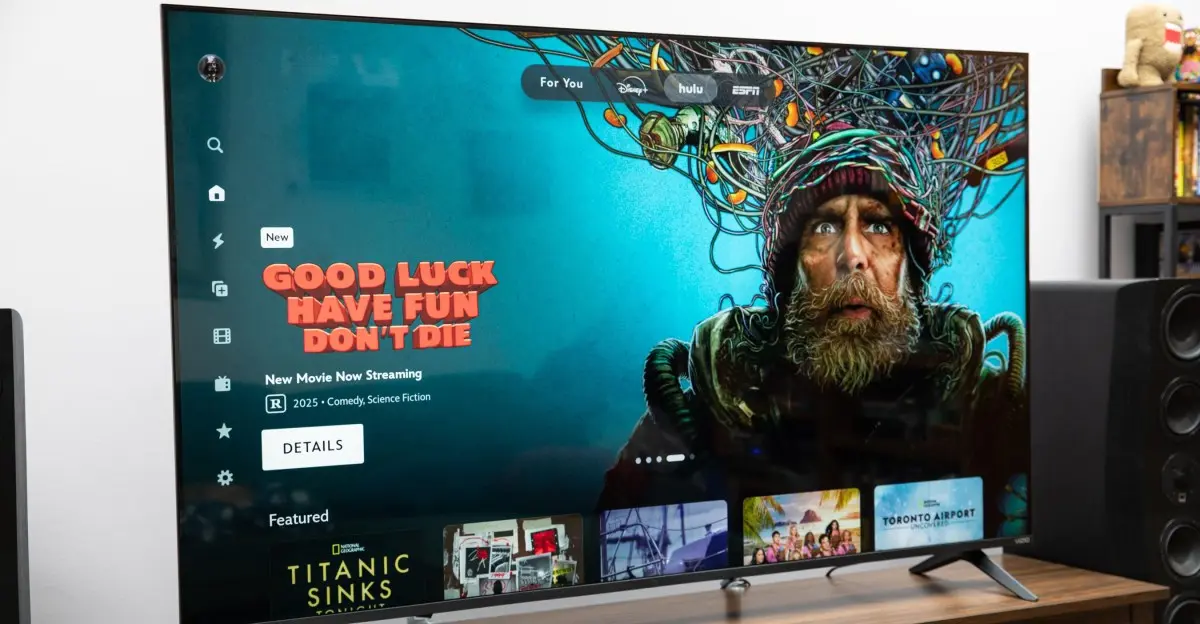
When Vizio released its Mini LED Quantum television, the initial reaction focused on the remarkable price point. A 65-inch quantum-dot television for under $400 seemed like a strong statement from the brand, which had been relatively quiet since its acquisition by Walmart in 2024. Quantum dots enable higher brightness levels and more accurate color reproduction, features typically reserved for more expensive models. Yet the true significance of this television lies not in its specs or price, but in what it represents for consumer privacy.
The Accidental Dumb TV
In an era where nearly every television sold is a smart TV, collecting data on viewing habits and serving targeted advertisements, the Vizio Mini LED Quantum offers a rare escape. During the initial setup, users are asked to sign in or create a Walmart account. If this step is skipped, a warning appears stating that managing payments and subscriptions or linking Vizio devices will not be possible. However, users who continue past this warning and decline the activity data policy are informed that they will miss out on all smart TV features, including apps like Netflix, YouTube, and others.
Declining one final time transforms the Vizio into a dumb TV: no operating system, three HDMI ports awaiting a signal, and complete freedom from data tracking. For users who take the additional step of disconnecting the television from the internet entirely by forgetting Wi-Fi settings or skipping network setup at the beginning, there is virtually no way for Walmart to collect viewing information. This capability is virtually unheard of in the current television market, where manufacturers increasingly rely on advertising revenue and user data as primary income streams.
Walmart's Data Ambitions
The acquisition of Vizio by Walmart was driven almost entirely by the television manufacturer's advertising business. At the time of the sale, Vizio's ad division was responsible for all of the company's profits. Walmart's priority is clearly maintaining and expanding that ad revenue, and Vizio's operating system is the primary vehicle for this strategy. The integration of Walmart accounts into the television experience is a direct reflection of this business model.
Users who choose to use the smart TV features must accept seven separate agreements for full functionality. These include Walmart's Terms of Use, Privacy Notice, and Mobile Alerts Terms of Use, as well as Vizio's Terms of Service, Privacy Policy, Activity Data acceptance, and Viewing Data consent. The potential for Walmart to use viewing habit data to target shopping app experiences is significant. Someone watching Star Wars content might later see recommendations for related Lego sets in their Walmart app. While some consumers may appreciate personalized recommendations, others find the close connection between television operating system and retailer unsettling.
This practice is not unique to Walmart and Vizio. Amazon employs a similar strategy with its Fire TV platform, using viewing data to inform product recommendations. However, the ability to completely bypass the operating system and avoid data collection altogether sets the Vizio apart from most competitors. Other smart TV platforms typically require acceptance of certain terms even when using external streaming devices connected via HDMI.
Technical Specifications and Performance
The Vizio Mini LED Quantum is available in sizes ranging from 43 inches to 85 inches. The 65-inch model retails for $398, while the 75-inch and 85-inch versions cost $498 and $768 respectively. The display uses Mini LED backlighting with quantum dots, which allows for superior brightness and color accuracy compared to standard LED televisions. The television supports Dolby Vision, HDR10+, HDR10, and HLG for high dynamic range content.
The audio system supports Dolby Atmos and DTS:X, though the built-in speakers, while loud, do not offer exceptional sound quality. This is a common issue across television price points, and most users will likely want to pair the television with a soundbar or external audio system. Connectivity options include three HDMI 2.0 ports, with one supporting eARC, a USB 2.0 port, an ATSC 1.0 tuner, and an optical audio output. Notably absent are HDMI 2.1 ports, which support higher bandwidth for features like 4K at 120Hz.
For gaming, the television supports 4K at 60Hz and 1080p at 120Hz on the 65-inch and larger models. This makes it suitable for console gaming on PlayStation 5 and Xbox Series X, though the lack of HDMI 2.1 limits some advanced gaming features like variable refresh rate and automatic low latency mode. The input lag is competitive for the price range, making the television responsive enough for casual and competitive gaming alike.
Picture Quality Analysis
Out of the box, the Vizio Mini LED Quantum offers several picture modes, with Calibrated and Calibrated Dark being the most accurate. Both modes lean slightly toward blue, giving images a cool cast. Calibrated Dark provides the best color accuracy and is ideal for a dark, light-controlled room. In SDR mode, the television reaches a maximum brightness of 309 nits, while HDR content achieves up to 579 nits with small highlights. The Calibrated mode reaches an impressive 936 nits for highlights, which is exceptional for a budget television.
The screen has a glossy finish, which can cause reflections from nearby lamps or windows, particularly during dark scenes. The television uses an IPS panel rather than a VA panel, which means black levels are not as deep as those found on more expensive televisions. There is some blooming visible around bright highlights in dark scenes, but for most viewers, the overall picture quality will be satisfying. Motion handling shows some blur with fast-moving content, such as Formula 1 races or action movies, but again, the performance is competitive for the price point.
Build Quality and Design
Cost-cutting measures are evident in several areas of the television's construction. The entire back panel is made of plastic that feels less premium than more expensive models. The feet have only one height position and cannot be adjusted, which limits placement flexibility. The cable management channels on the back of each foot are only large enough for a single cable, so users with multiple connected devices will not be able to route all cables through the channels.
The included remote is small and functional, but it feels inexpensive. It includes direct buttons for popular streaming services and an input button for switching between connected devices. The television's operating system, when activated, supports all major streaming apps, AirPlay, and Google Cast. Navigation is generally smooth, though occasionally sluggish. The screensaver mode, which activates after a few minutes of inactivity, displays channels from the WatchFree+ service featuring AI-generated scenes with music. Unfortunately, these are interrupted by advertisements periodically, making the experience less relaxing than traditional screensavers.
The Broader Context of Smart TV Data Collection
The Vizio situation is part of a larger trend in the television industry. Nearly all smart TV platforms collect data on what users watch, how they watch it, and even what is displayed on screen through HDMI inputs. This data is used to serve targeted advertisements and recommendations, and in many cases, it is shared with third parties. Vizio was caught collecting viewing data without consent in 2017, resulting in a settlement with the Federal Trade Commission. The company paid $2.2 million and agreed to obtain explicit consent from users before collecting such data.
Despite regulatory actions, the practice has become more sophisticated and pervasive. Televisions now monitor HDMI inputs for content metadata and can track viewing patterns across multiple devices connected to the same network. The integration of retailers like Walmart and Amazon into the television operating system creates a direct pipeline from entertainment consumption to shopping recommendations. This convergence of entertainment and commerce raises significant questions about digital privacy and the extent to which consumers are willing to trade personal information for convenience.
The ability to use the Vizio Mini LED Quantum as a dumb television represents a rare opportunity to opt out of this ecosystem entirely. However, this capability may be unintentional and could be removed through future software updates. If Walmart requires users to accept all activity data collection in order to use the television, the recommendation becomes more difficult. The television currently allows users to skip network setup during initial configuration, which immediately switches the input to HDMI and bypasses the entire operating system. Users who do this will miss out on firmware updates, which could be a concern for long-term security and performance.
Comparing to Other Budget Options
In the budget television market, the Vizio Mini LED Quantum competes with offerings from TCL, Hisense, and Amazon's Fire TV lineup. TCL's 5-series and 6-series televisions offer similar quantum-dot technology at comparable price points, but they require acceptance of data collection terms to use their smart platforms. Hisense's U6 and U7 series also provide strong performance for the price, with the same data collection caveats. Amazon's Fire TVs integrate closely with the Amazon ecosystem, using viewing data to inform shopping recommendations and advertising.
What sets the Vizio apart is the genuine ability to sever the internet connection and use the television purely as a display. Other brands may allow users to disable specific tracking features, but they typically require some level of platform acceptance. The Vizio's setup process is uniquely permissive in this regard, allowing users to decline all terms and still use the television as a display for external devices. This makes it an attractive option for consumers who are privacy-conscious but still want modern display technology like quantum dots and Mini LED backlighting.
The trade-offs are clear: limited connectivity, a plastic build that feels less premium, and the possibility that future software updates might close this loophole. For users who are comfortable with some data collection, the Vizio OS is functional and supports all major streaming services. The television's performance, while not matching high-end models, is more than adequate for everyday viewing, sports, and gaming. The combination of quantum dots and Mini LED backlighting at this price point is genuinely impressive, delivering brightness and color that outperforms televisions costing significantly more.
Technical Deep Dive: Mini LED and Quantum Dots
Mini LED technology uses thousands of tiny light-emitting diodes arranged in zones to provide backlighting for the LCD panel. This allows for more precise control over brightness and darkness compared to standard LED backlighting, resulting in better contrast and reduced blooming around bright objects. Quantum dots, on the other hand, are microscopic semiconductor particles that convert light into specific colors. When applied to a layer in front of the backlight, they produce more saturated and accurate colors than traditional white LED backlighting.
The combination of these two technologies in a budget television is relatively new. Mini LED was previously reserved for high-end models due to the complexity and cost of manufacturing. Quantum dots also added significant expense until recently. Vizio's ability to bring both technologies to a $400 price point demonstrates how rapidly display technology is evolving and how competitive the television market has become. The trade-off, as noted, is the use of an IPS panel rather than VA, which affects black levels but provides wider viewing angles.
For most viewers, the overall picture quality will be satisfying and significantly better than what was available at this price point just a few years ago. The television handles HDR content well, with enough brightness to produce impactful highlights. Standard definition and HD content are upscaled adequately, though not as sharply as on more expensive televisions with better processing. Motion interpolation, which can reduce blur in fast-moving scenes, is available but can introduce the soap opera effect that some viewers find unnatural.
Gaming Performance and Features
For gamers, the Vizio Mini LED Quantum offers solid performance within its limitations. The 1080p at 120Hz support on 65-inch and larger models is a notable feature for competitive gaming, providing smoother motion and reduced input lag. At 4K, the television operates at 60Hz, which is standard for this price range. Input lag is approximately 10-15 milliseconds in Game mode, which is responsive enough for most players. The lack of HDMI 2.1 means variable refresh rate and automatic low latency mode are not supported, but these features are still rare on budget televisions.
PlayStation 5 and Xbox Series X owners will still enjoy a good experience, with HDR gaming supported and the television's brightness providing vibrant colors. The quantum dot layer ensures that game graphics pop, and the Mini LED backlighting reduces halo effects around bright objects on dark backgrounds. For competitive games that benefit from higher refresh rates, the 1080p at 120Hz mode is a welcome addition, though it requires the game to support that resolution and refresh rate combination.
Final Assessment of the Vizio Experience
The Vizio Mini LED Quantum television represents a fascinating case study in the evolving relationship between hardware manufacturers, retailers, and consumers. Walmart's acquisition of Vizio was a bet on advertising and data, not television manufacturing. Yet the product that emerged from this acquisition offers something genuinely unusual: a high-quality display that can be used without participating in the data economy. Whether this is intentional or an oversight remains to be seen, but for now, it provides a valuable option for privacy-conscious consumers.
The television's performance is impressive for its price, with quantum dots delivering vibrant colors and Mini LED backlighting providing solid contrast. The limitations in connectivity, build quality, and HDMI specifications are acceptable trade-offs given the cost. The ability to use the television as a dumb display, combined with the option to add an external streaming device like an Apple TV, Roku, or Fire TV Stick, creates a flexible setup that puts control back in the hands of the user.
For those who value privacy and want to avoid the tracking that has become standard in the smart TV industry, the Vizio Mini LED Quantum is currently the best option available. The caveat is that this capability may not persist indefinitely. Software updates could remove the ability to bypass the operating system, and users who choose to use the smart features should carefully review the privacy settings and understand what data is being collected. The television offers a rare glimpse of what consumer electronics could be if manufacturers prioritized user choice over data extraction.
Source: The Verge News