

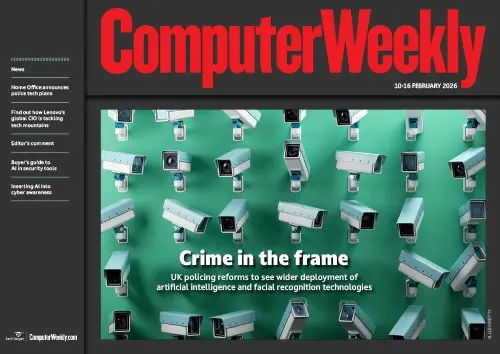
The latest edition of Computer Weekly delves into the Home Office's ambitious plans to transform policing through technology, as part of a wide-ranging reform programme. The ezine also features an exclusive interview with Lenovo's global CIO, Art Hu, on the company's pivot toward services, and a Security Think Tank piece that cuts through the hype around artificial intelligence in cybersecurity. Below are the key takeaways from each feature.
Home Office announces sweeping police technology plans
The Home Office has unveiled a comprehensive set of reforms that will significantly expand the use of artificial intelligence and facial-recognition technologies within UK policing. According to the article by Sebastian Klovig Skelton, the government intends to ramp up the deployment of these tools as part of a broader effort to modernise law enforcement. The reform programme includes plans for a national police data platform, increased use of biometrics, and a renewed focus on predictive analytics.
These proposals have sparked debate about civil liberties and the potential for bias in AI systems. Critics argue that facial recognition technology, in particular, raises serious privacy concerns and has been shown to be less accurate for people of colour. The Home Office counters that these tools will help solve crimes more efficiently and free up officers for frontline duties. The article also notes that the reforms will require significant investment in training and infrastructure, as well as robust oversight mechanisms to ensure accountability.
Historically, UK policing has been slow to adopt new technologies, often relying on outdated systems. The current push is partly a response to rising cybercrime and the need for better data-sharing across forces. If implemented successfully, these changes could set a precedent for other countries grappling with similar challenges. However, the article warns that the pace of implementation will be critical, as past initiatives have been hampered by delays and cost overruns.
Interview: Art Hu, global CIO, Lenovo
In an interview with Mark Samuels, Lenovo's global CIO Art Hu discusses how the company is leveraging its internal technology expertise to grow its services business. Hu, who has been with Lenovo since 2015, oversees the IT strategy for the world's largest PC manufacturer. He explains that the company's shift toward services—ranging from device-as-a-service to managed infrastructure—is being driven by insights gained from its own digital transformation.
Lenovo has invested heavily in automation and AI to improve its supply chain and customer experience. Hu notes that these same technologies are now being offered to clients, helping them modernise their operations. The interview highlights Lenovo's efforts to move beyond hardware sales and compete with established service providers like Dell Technologies and Hewlett Packard Enterprise. Hu emphasises that the key differentiator is Lenovo's deep understanding of device management, which gives it an edge in endpoint security and lifecycle services.
Hu also discusses the challenges of scaling a services business in a traditionally product-centric company. Cultural change, talent acquisition, and aligning incentives are all critical. He points to the success of Lenovo's internal IT department as a proof point, showing that the same practices can benefit external customers. The interview provides a rare glimpse into the strategic thinking of a major tech company as it navigates the shift from hardware to solutions.
Security Think Tank: Stop buying AI, start buying outcomes
The Security Think Tank feature, written by Rik Ferguson, advises CISOs and security buyers to focus on desired outcomes rather than getting swept up in the AI hype. Ferguson argues that many vendors are rebranding existing tools as AI-powered without adding real value. He urges buyers to ask pointed questions: What specific problem does the AI solve? How is it trained? What are the false positive rates?
The article outlines several use cases where AI genuinely improves cybersecurity, such as anomaly detection in network traffic, automated threat hunting, and phishing analysis. However, it warns that AI is not a silver bullet. Over-reliance on AI can lead to alert fatigue and a false sense of security. Ferguson recommends that organisations start with small, measurable pilots before scaling AI investments.
He also highlights the importance of human oversight. AI systems can be brittle and may fail in unexpected ways, especially when facing adversarial attacks. The piece draws on real-world examples, including a case where an AI-based security tool missed a known malware variant because it had been trained on incomplete data. The conclusion is pragmatic: CISOs should treat AI as one tool among many, integrated into a broader security architecture that includes robust processes and skilled personnel.
This feature is particularly timely given the rapid adoption of generative AI tools in enterprises, which themselves introduce new risks. Ferguson notes that security teams must stay ahead of adversaries who are also using AI to automate attacks. The key is to invest in outcomes—reduced mean time to detect, faster incident response—rather than chasing the latest technology label.
Source: Computerweekly News