

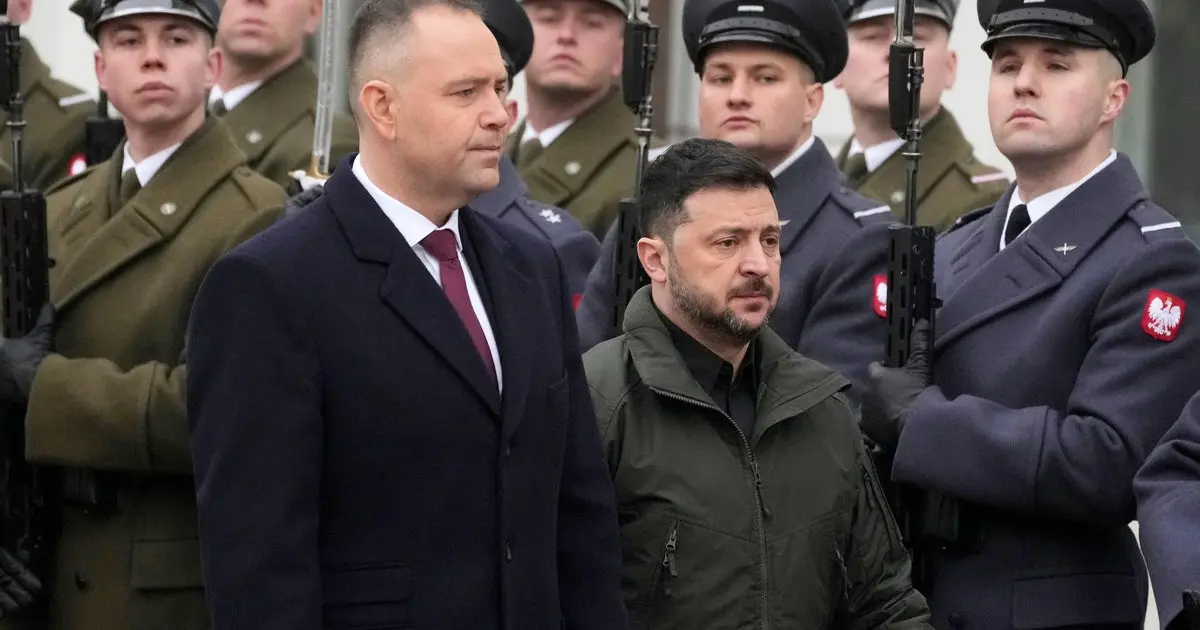
Ukrainian President Volodymyr Zelenskyy has returned Poland's highest state honor, the Order of the White Eagle, after Polish President Karol Nawrocki revoked the award in a politically charged dispute over World War II history. The controversy erupted following Zelenskyy's May 26 decree that named a unit of Ukraine's Special Operations Forces after the Ukrainian Insurgent Army (UPA), a paramilitary organization that operated in the 1940s and 1950s and has long been accused by Poland of mass killings of ethnic Poles.
In a social media post on X, Zelenskyy explained that Ukrainians believed the order "was meant for the Ukrainian People and our army." He added, "Today, I sent the Order back to the President of Poland. I believe the future will confirm the respect Ukrainians deserve." The post included photos of the Polish order and a postal receipt indicating it was being mailed to the Polish presidential office. The gesture effectively turned a unilateral revocation into a symbolic act of self-respect, but it also deepened the rift between two key allies at a critical time in Russia's ongoing war against Ukraine.
Historical Roots of the UPA Controversy
The Ukrainian Insurgent Army was formed in 1942 as the armed wing of the Organization of Ukrainian Nationalists (OUN). Its primary goal was to establish an independent Ukrainian state, fighting against both Nazi Germany and the Soviet Union. However, in the chaotic years of World War II, the UPA also conducted a brutal campaign against ethnic Poles in the Volhynia and Eastern Galicia regions (then under Nazi occupation), which included mass killings, forced deportations, and the burning of villages. Polish historians estimate that between 60,000 and 120,000 Poles were killed by UPA units between 1943 and 1944, often in coordinated attacks known as the Volhynia Massacres. In 2016, the Polish Parliament formally recognized these crimes as genocide.
Ukrainians, however, argue that the conflict was bilateral, with Polish underground forces—such as the Home Army—also committing atrocities against Ukrainian civilians. Moreover, the UPA is revered in Ukraine as a symbol of resistance against Soviet domination, and many Ukrainians see its legacy as part of the broader struggle for national self-determination. This divergence in historical memory has long been a source of tension between the two nations, even as they have built a strong partnership in the face of Russian aggression.
The Decree That Sparked the Row
On May 26, Zelenskyy signed a decree bestowing the honorary name of the Ukrainian Insurgent Army onto the 3rd Separate Special Forces Regiment of the Ukrainian Special Operations Forces. The decision was framed as a measure to restore military traditions and recognize the unit's battlefield performance against Russian forces. The regiment has been involved in numerous operations since the start of Russia's full-scale invasion in 2022, including missions in the Donbas, the Zaporizhzhia front, and behind enemy lines in Crimea.
Polish President Nawrocki, a nationalist politician who has often used anti-Ukrainian rhetoric to appeal to his domestic base, reacted strongly. In a 13-minute address on social media, he declared that for the majority of Polish society, the Ukrainian Insurgent Army remains "a formation responsible for cruel crimes against the citizens of the Polish Republic during World War II." Nawrocki subsequently revoked the Order of the White Eagle that former Polish President Andrzej Duda had awarded to Zelenskyy in 2023 for his contributions to security, resilience, and the defense of human rights.
Nawrocki's decision was seen by many as a calculated move to exploit nationalist sentiment ahead of upcoming elections, particularly at a time when anti-Ukrainian prejudice has been rising in Poland despite the country's hosting of millions of Ukrainian refugees. Poles, while largely supportive of Ukraine's fight against Russia, have grown increasingly frustrated with issues such as competition for jobs, grain imports, and historical grievances.
Ukrainian Reactions and Broader Consequences
The revocation drew swift condemnation from Kyiv. Kyrylo Budanov, head of Ukraine's Presidential Office, wrote in a Telegram post that Nawrocki's decision was "an unfriendly act toward our people" and "a gift to the Moscow aggressor, which will certainly use it against both of our countries." Budanov and three other high-ranking Ukrainian officials announced that they would return state honors previously awarded to them by Poland, escalating the diplomatic spat.
However, not all Ukrainians supported this course of action. Arseniy Yatsenyuk, Ukraine's former prime minister, argued on X that one "harmful and incorrect decision by the current president of Poland cannot be corrected by other incorrect decisions of ours." He urged restraint, noting that the most important issue is maintaining unity against Russia. The debate highlighted the delicate balancing act Ukraine faces as it tries to preserve its many international alliances while asserting its own historical narratives.
Poland has been a steadfast supporter of Ukraine since the start of the war, providing military aid, humanitarian assistance, and a crucial logistical hub for Western weapons. Polish airports and railway stations have facilitated the delivery of billions of dollars in military equipment. Millions of Ukrainian refugees have found shelter in Poland, and Polish civil society has been remarkably generous. But the UPA issue has always lurked beneath the surface, occasionally flaring up—as it did in 2023 when a Polish trucker blockade at the border targeted Ukrainian agricultural products, citing unfair competition and historical grievances.
Efforts to De-escalate
Polish Prime Minister Donald Tusk, a political rival of Nawrocki, urged both sides to "tone down emotions, not stoke tensions." He wrote on social media, "The front line runs elsewhere," adding that the row between Poland and Ukraine "delights Putin and shocks our allies." Tusk's comments reflect a pragmatic understanding that disunity between Warsaw and Kyiv plays directly into Russian propaganda, which has long sought to exploit historical divisions among Slavic nations.
Zelenskyy, in his post, struck a conciliatory note, emphasizing that Ukraine is grateful for Poland's support and remains open to resolving historical differences through dialogue. He said, "I am proud of our people and of EVERY Ukrainian warrior." The Ukrainian leader's decision to return the award can be interpreted as both a principled stand and an attempt to control the narrative after being stripped of the honor.
Despite the turmoil, Poland is scheduled to host a major international conference on Ukraine's postwar reconstruction next week, which Zelenskyy was expected to attend. It remains unclear whether the diplomatic row will affect his participation or the event's broader objectives. However, both countries have a strong incentive to move past the incident—Ukraine needs Poland's continued support and logistical access, while Poland's long-term security interests are tied to a stable, independent Ukraine free from Russian domination.
The UPA issue is unlikely to be resolved quickly. The 2016 Polish genocide recognition remains a point of contention, and recent progress on the exhumation of Polish victims from mass graves in Ukraine has been slow. In December, a meeting between Zelenskyy and Nawrocki in Warsaw had seemed to signal a thaw, but the naming of the military unit has reversed that progress. Nonetheless, many analysts note that both societies have more to gain from cooperation than from quarrels over historical interpretation, especially when a common enemy—Russia—is actively seeking to exploit their divisions.
Source: Cbsnews News