

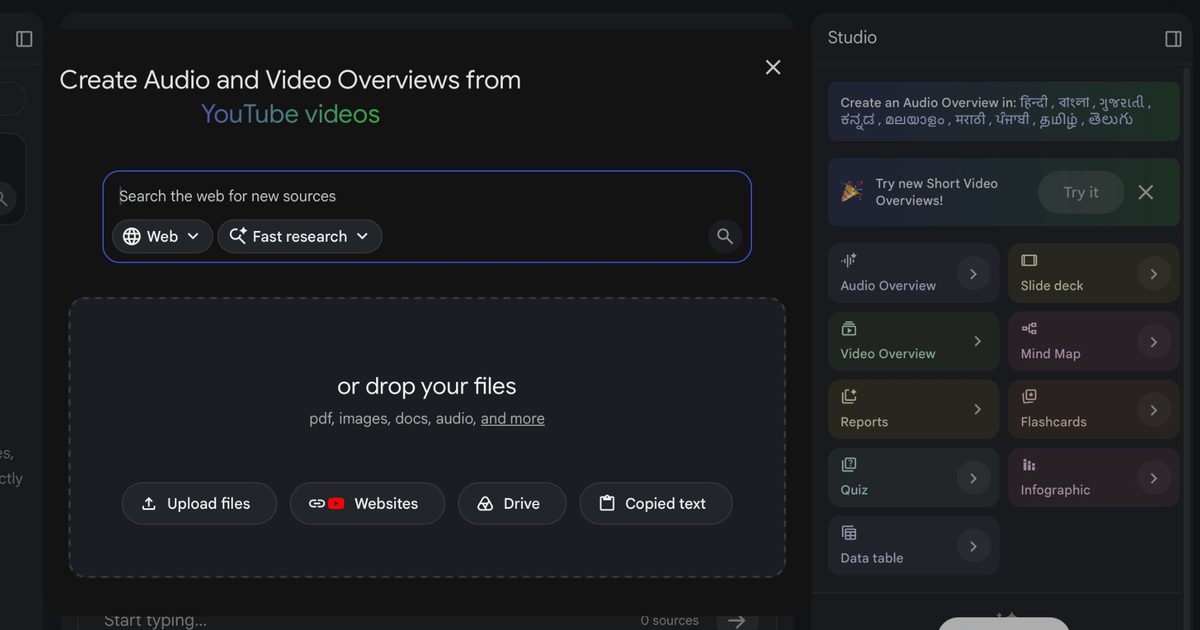
Short videos have taken over just about every app we use. You scroll through them on X, lose track of time on Instagram, watch them on YouTube, and now even Netflix has its own bite-sized feed. So when it was announced that Google was bringing the format to NotebookLM, it felt both surprising and completely inevitable at the same time.
Google has announced Short Video Overviews for NotebookLM, a feature that turns dense documents and complicated sources into 60-second vertical videos that explain key ideas. Instead of staring at pages of notes, you get a quick visual walkthrough of the concept you're trying to understand. NotebookLM itself is an AI-powered research and note-taking assistant that launched in 2023, initially designed to help users interact with their uploaded documents through chat and summarization. The addition of video overviews marks a significant expansion of its capabilities, moving from text-based assistance to multimedia content generation.
Finally, a short video your brain will thank you for
Introducing this feature feels like one of those ideas where you wonder, "Why didn't this exist sooner?" Visual explanations have long been proven to enhance comprehension and retention. Cognitive load theory suggests that presenting information through multiple channels—visual and auditory—reduces the mental effort required to process complex material, making learning more efficient. If a concept is explained visually, it sticks much better than reading the same paragraph three or four times. Having NotebookLM available during a university psychology thesis would have allowed anyone to happily watch a handful of one-minute videos instead of digging through dozens of pages every time a refresher was needed.
The practical application of this feature is perhaps most evident in education. Students often face the daunting task of reviewing voluminous notes before exams. NotebookLM's Short Video Overviews can transform those notes into concise, engaging videos that highlight key points. The feature also integrates with other Google productivity tools, allowing users to upload PDFs, Google Docs, and even web articles. The AI analyzes the content, identifies the most important concepts, and generates a script accompanied by relevant visuals—charts, diagrams, or stock footage—to create a coherent video.
The potential for this feature extends beyond students. Content creators, particularly those in educational or faceless content niches, spend hours turning research papers, PDFs, reports, or long notes into something people will actually watch. If NotebookLM can handle the first draft of that process by creating a concise visual overview, that represents a significant time savings. The feature also supports multiple audio styles and voice options, allowing users to customize the tone of the narration to match their preferred learning style.
This also feels like a nice twist on our collective obsession with short videos. We are already spending hours flicking through vertical videos every day. The average person spends nearly two hours per day on social media platforms, much of that on short-form content. If some of those minutes can be redirected toward educational material without changing the format, it could transform how people consume information. YouTube's push into Shorts and Instagram's pivot to Reels have already created an audience primed for vertical video consumption. NotebookLM leverages this existing behavior.
We've officially optimized our brains for 60 seconds
As exciting as this feature is, it also prompts an uncomfortable thought. The reason it is instantly appealing is probably the same reason it exists in the first place: attention spans are not what they used to be. Research from Microsoft in 2015 suggested that the average human attention span had dropped to eight seconds, and the proliferation of short-form content since then has likely accelerated that trend. When Google says it can turn dense notes into a 60-second video, the natural reaction is, "Honestly, I'd use that." The irony is that this feature is solving a problem that has slowly been created: brains trained to expect information in bite-sized pieces, and now tools are being built to fit that consumption pattern.
However, this is still a net positive. If those same 60 seconds that would have been spent mindlessly scrolling can instead help understand a concept, revise a chapter, or finally make sense of something that has been put off, that is a worthwhile trade. NotebookLM's video generation process includes built-in fact-checking and citation, ensuring that the videos are not just entertaining but accurate. The AI cross-references the generated content against the original sources, flagging any potential discrepancies. This is particularly important for academic and professional use cases where misinformation could have serious consequences.
The feature also allows users to control the depth of the overview. By adjusting parameters, users can request a high-level summary or a more detailed breakdown, depending on their needs. This flexibility makes it suitable for both quick reviews and deep dives. Additionally, NotebookLM saves the generated videos within the user's notebook, allowing for easy playback and sharing. This creates a searchable library of video summaries that can be revisited at any time.
Not in the club yet? You won't be waiting long
Google is rolling out Short Video Overviews to NotebookLM AI Pro and AI Ultra subscribers on both mobile and the web. Early testers report that the feature works seamlessly, integrating directly into the NotebookLM interface. After spending time with it, it is easy to see using it far more often than expected. The video generation process takes only a few seconds, and the quality of the output is impressive—clear narration, relevant visuals, and a pace that matches the complexity of the content.
There are a couple of limitations for now. The feature currently works only with English-language sources, so if notes or documents are in another language, users will have to wait a little longer. Google is expected to expand language support over time, just as it has with many of its other AI features. The company has a track record of rolling out multilingual support for products like Google Translate and Google Assistant, and NotebookLM is likely to follow the same path. Additionally, the feature is optimized for text-heavy documents; content with heavy tables, equations, or mixed media may not translate as effectively into a video format.
For free NotebookLM users, the feature will become available soon. Google has confirmed that this feature will be provided to free users, though possibly with usage limits. The company is likely using the paid tier rollout to gather feedback and refine the experience before a wider release. In the meantime, users can explore other features of NotebookLM that are already free, such as document chat, audio overviews (the podcast-style summaries introduced earlier), and search-enhanced notes.
The broader implications of this feature are worth considering. Short video overviews could disrupt the way educational content is created and consumed. Traditional textbook publishers and e-learning platforms may need to adapt to this new format. Similarly, corporate training and professional development programs could benefit from converting lengthy manuals and reports into digestible videos. NotebookLM is positioning itself not just as a note-taking tool but as a comprehensive knowledge management platform that adapts to modern content consumption habits.
From a technical perspective, Short Video Overviews rely on Google's advanced text-to-speech and image generation models. The system uses a combination of natural language processing to extract key points and a diffusion model to generate illustrative images on the fly. Google's investment in multimodal AI—models that can process and generate text, images, and sound—is clearly paying off in this application. The feature also respects user privacy: documents uploaded to NotebookLM are not used to train the underlying models, and all processing occurs within Google Cloud's secure infrastructure.
As the feature rolls out, it will be interesting to see how educators adopt it. Some may worry that students will rely too heavily on generated videos instead of reading original sources. However, proponents argue that the videos serve as a gateway, making complex topics approachable and sparking curiosity to learn more. The key is using the feature as a supplement, not a replacement. NotebookLM itself recommends that users watch the videos alongside the original documents to cross-reference and dig deeper.
In summary, NotebookLM's Short Video Overviews represent a thoughtful adaptation of AI to solve a real problem: the challenge of processing dense information in a world of shrinking attention spans. By meeting users where they already are—in the vertical video feed—the feature has the potential to make learning more accessible and enjoyable. Whether it's for studying, content creation, or professional development, the ability to turn any document into a 60-second video is a powerful tool. And with free access coming soon, it is a tool that will soon be available to nearly everyone.
Source: Digital Trends News