

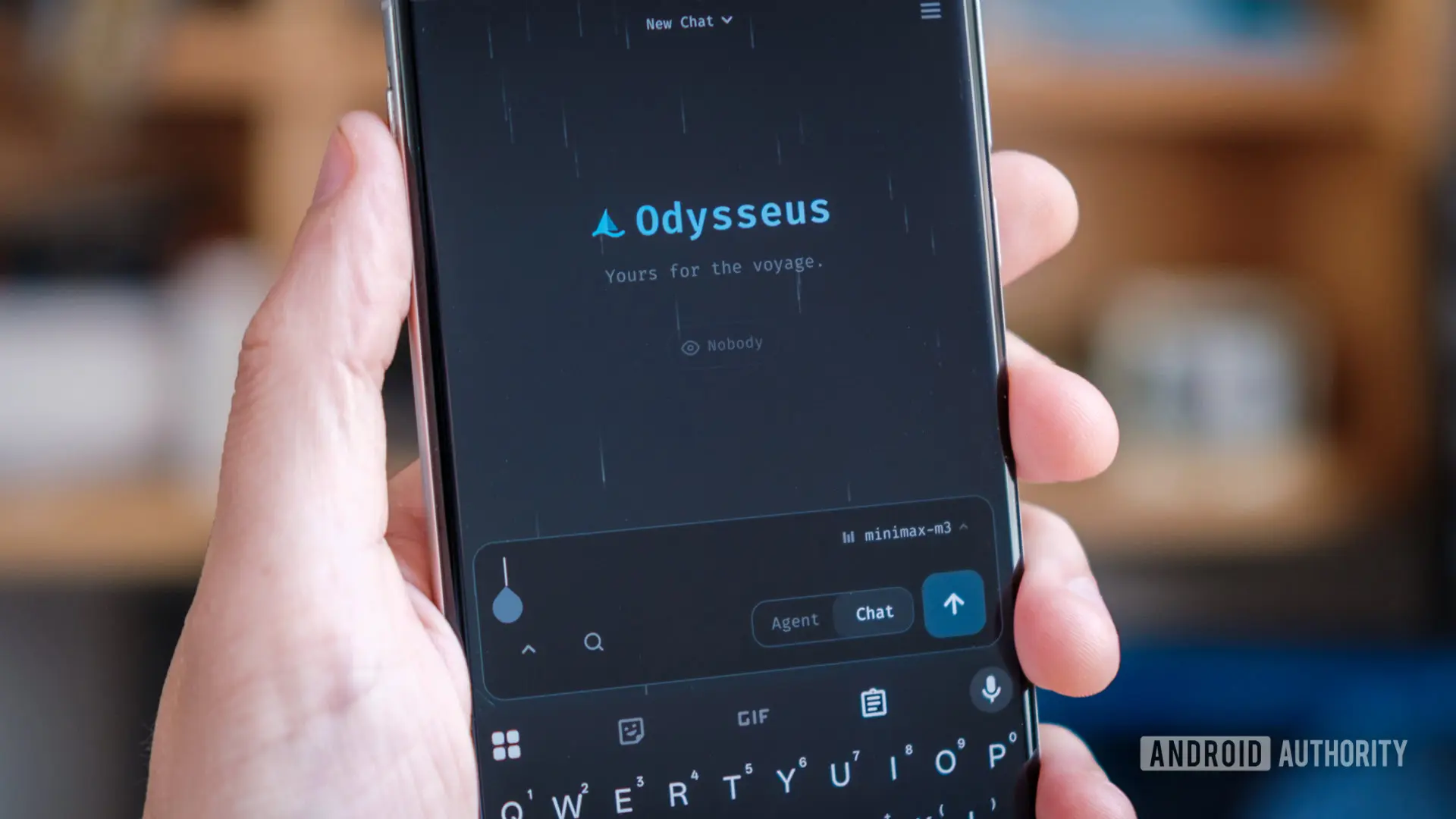
AI coding and workspace platforms are now ubiquitous, but few come from the mind of a famous YouTuber. Surprisingly, PewDiePie—known for his gaming and commentary—has developed an AI workspace called Odysseus. The YouTuber has quietly become a proponent of powerful Linux and AI tools, making this project a natural extension of his interests. For those unfamiliar with the concept, an AI workspace is a platform that enables artificial intelligence to interact with various tools and data, functioning as a coding environment or a personal assistant for documents and emails.
What immediately drew my attention to Odysseus is its privacy-first design. The system is built for self-hosting, and assembling it into a Docker image for my DIY NAS was straightforward. This approach ensures that emails, documents, personal information, and any other data shared with large language models remain under your control, rather than being stored or exploited by third-party companies.
Setting Up Odysseus: Models and Cookbook
Odysseus is explicitly designed to support self-hosting your own AI models, guaranteeing that no data ever leaves your infrastructure. One of the first user-friendly features I encountered is the "Cookbook," which surfaces a wide array of models and their quantized versions from Hugging Face. The Cookbook ranks them by compatibility and size relative to your GPU. For someone who has used LM Studio and Ollama to run local models, this interface is familiar but more accessible, simplifying the process of testing and managing models on personal hardware.
Given the high cost of cutting-edge RAM and GPUs, I cannot currently run the most powerful models locally. Odysseus therefore accommodates bring-your-own cloud-hosted models via OpenRouter or similar API key setups. This hybrid approach is acceptable: data remains on my premises, and I only need to trust that the API endpoints are not logging all my chats—a reasonable compromise for now.
Familiar AI Features Without the Subscriptions
As someone who frequently dives into technical specifications and emerging technologies, I have become a fan of deep research tools found in ChatGPT and Gemini. While I do not rely on them blindly, deep research provides an excellent starting point for exploring projects or summarizing established fields. However, I am unwilling to pay $20 per month for only 25 queries, which are often restrictive.
Odysseus includes deep research as part of its bring-your-own-model philosophy. It searches through multiple web results, distills information, and outputs a nicely formatted web document. Having control over the models is beneficial: you can run the same research task with two or three models to ensure no omission or misinterpretation occurs.
Deep research is just one component of a familiar toolset. Odysseus AI chats support web browsing, file attachments (images and documents), and even prefix and suffix prompts to fine-tune responses. In essence, you are not missing features from ChatGPT or Gemini—except perhaps image generation. Moreover, Odysseus offers some unique tools.
More Than Your Traditional AI Chat
A particularly interesting feature is Persona, which allows you to save recallable system prompts for conversations. The defaults are whimsical—like impersonating Socrates—but I have successfully set up personas for proofreading, grammar checking, and eliminating passive voice from my article drafts. This functionality feels similar to Custom GPTs or Gemini Gems.
You can also introduce multiple personas into a single group chat, enabling several AI models with their own system prompts to interact with each other's responses. While I have not yet found a practical use case, it could be valuable for cross-checking ideas or catching errors when solving complex problems. Odysseus also includes scheduled tasks, automated email summaries, and a built-in calendar.
Document co-editing is a feature I have found particularly useful. It allows agents to work alongside you on markdown documents, code files, CSV spreadsheets, and PDFs. This is helpful for drafting and reviewing work or debugging short code snippets. Workspaces extend this capability by granting agents access to a dedicated folder and all its contents, rather than the limited documents stored in the SQLite database. Although I have not yet connected it to a coding project, I imagine it could serve as an alternative to Claude, Codex, or OpenCode for certain tasks.
Workspaces are not as dangerous as some other tools because Odysseus runs in a Docker container with carefully scoped access to specific locations, bound by Docker and Linux user permissions. The agent cannot read your entire file system, only the folders you expose. However, shell commands can still reach out of the designated workspace folder to affect other files in the Odysseus file path, so caution is warranted.
Learning as We (Both) Go
Odysseus supports IMAP and SMTP email clients, CalDAV calendars, MCP Tool servers, and other API integrations, allowing agents to reach across multiple tools. Google Calendar is not supported, and email summarization did not work in my testing. There is also an image editor and a to-do list that I have not yet explored. The system still requires more learning on my part before it feels like a true personal assistant.
One of the most fascinating aspects is its "self-learning" capability. Agents automatically keep notes during interactions, forming memories of your identity, preferences, and important aspects of your work. The workspace quickly identified me as an editor and began noting things like "values scientific accuracy in technical writing" and "has strong technical knowledge of battery physics and power bank specifications." It is a surprisingly perceptive system.
You can add, delete, or edit these memories to keep them on the right track. Agents also create and refine their own skill sets to solve tasks, or you can download or write skills for them. Self-developed skills come with a confidence score indicating how well they perform a task—a smart approach to self-learning and improvement over time.
While ChatGPT and Gemini also include personalized learning, Odysseus feels both smarter and more transparent. Moreover, when memory data is deleted, it is truly gone. The development of self-reinforcement skills and memory refinement makes the platform more powerful and tailored to your needs the longer you use it. I cannot say the same for my countless hours with ChatGPT.
After spending several weeks with Odysseus, I have glimpsed the near future of more powerful and useful AI tools. Deeper support for office document types, easier cloud calendar integration, and improved workspace file management would be welcome, but the platform already accomplishes a great deal. Code contributions are increasing rapidly. The self-learning, unique chat features, and bring-your-own-agent approach are refreshing in a sea of similar "agentic" platforms. The privacy angle is an added bonus.
Honestly, I am impressed by what PewDiePie and his AI agents have built. So much so that I intend to keep Odysseus as my primary AI workspace—a sentiment I never expected to express when I started this journey.
Source: Android Authority News