

Subscribe to the Show Notes newsletter for on-the-ground intel from fashion weeks and the wider world of men’s fashion.
There are lots of brands that set and chase trends, but Giorgio Armani has never been one of them. Its power is in its consistency—its ability to take the same shapes and ideas and refine and refine and refine, season after season, like polishing marble.
Leo Dell’Orco and Silvana Armani, the house’s co-creative directors appointed following founder Mr. Armani’s passing in September, are proving masters at it. They invited guests into the courtyard of Milan’s Palazzo Orsini, where handheld fans and spritzing bottles were pressed into grateful, sweaty hands. Fresh glasses of water became hot commodities, fought over more than champagne—a rare sight among fashion editors. The setting was fitting, as the collection was inspired by a Mediterranean marketplace.
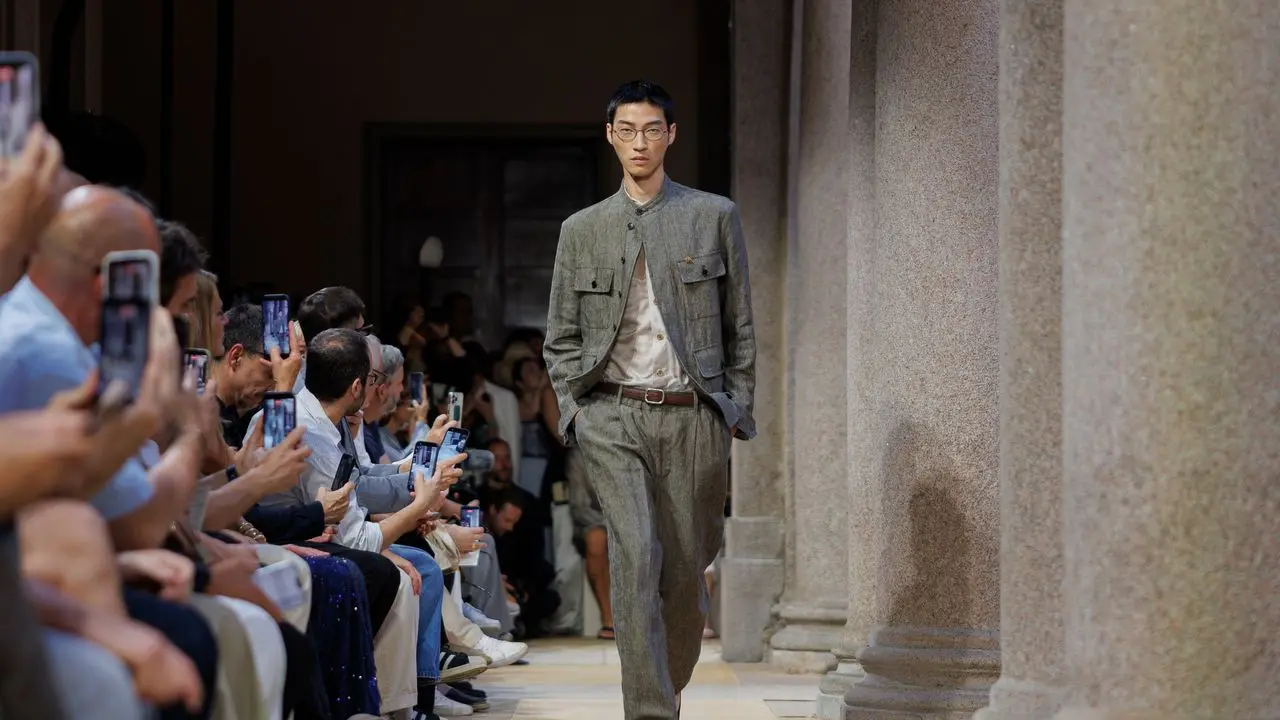
Dell’Orco and Armani clearly enjoyed playing with that theme in the clothes. One could imagine many of the looks out in some portside town, holding bags of produce and sipping espressos. Jackets and shirts were faded along the shoulder seams and collar, as if bleached by sun and saltwater. Other looks included multipocketed field jackets and raffia hats. At other points, things got professorial with bookish cardigans, ties, and wire-framed reading glasses. Everything came in a restrained palette of sage green, pale pink, lilac, and navy, until the end when a coda of black suits closed the show, some with collarless blazers, others worn over sheer shirts.
At 160 looks, it was one of the largest collections shown in Milan this season. It ranged from casual—at least the Armani version of casual, with breezy linen trousers and short-sleeved shirts—to formal, with soft-shouldered suits in high-shine fabrics paired with silk blouses. Surprisingly, the button-ups were the standouts. The T-shirt, a signature of Mr. Armani, was set aside in favor of its more formal cousin, which appeared in all forms: washed denim under a textured double-breasted blazer, a sheer organza number revealing some chest, and others cut from a rough, slubby fabric that looked like it had lived a life before reaching the runway.
Mostly, things stayed close to the Armani core: fluid, relaxed, and handsome, at home on a yacht deck or enjoying a 4 p.m. lunch in the sun. Much of it felt as though it could have been shown during Armani’s ’90s heyday, as if the designers had paid extra close attention to the archival grails the label recently reissued. This approach resonated well with both editors and clients in the audience.
Stanley Zhu, a friend of the house and longtime vintage collector with a closet full of ’80s and ’90s Armani, noted that to most disciples of archival fashion, modern pieces rarely measure up. But for Zhu, the Armani of 2026 is just as good as the Armani of 1986. In some ways, “it’s even better,” he said. “The fabric this season is much lighter. I think the vintage is much more formal.” This latest collection, he felt, is easier to wear but no less special. “I almost cried,” said Zhu, laughing.
Channatip Chanvipava, a painter wearing an inky navy collarless suit, found the footwear compelling. “My eyes were very much fixated on the shoes. I think the men’s shoes look absolutely delicious and comfortable,” he said. Based between Bangkok and London, Chanvipava noted that his Armani pieces hold up in both English rain and Thai humidity. “It’s all about layering and unlayering, depending on whatever the weather is and what the occasion is.”
Throughout Milan Fashion Week, the heat was oppressive, and every conversation began with “It’s so fucking hot!” and ended with “Stay cool!” Many models suffered in skintight leather at Prada or layered formal suits and netted hats at Thom Browne, but not at Armani. Despite temperatures exceeding 100°F at 6 p.m., the models did not appear to be overheating. “It feels comfortable,” said model Max Knott after the show. He walked the runway wearing a wide-gauge knit and trousers. Fellow model James Yates, who has walked for Armani multiple times and owns several pieces, crossed the courtyard to agree: “There’s plenty of brands that are… not quite so comfortable,” he said. “I’m not going to name any names, but Armani is always comfortable.”
To Yates, the looks represented “classic Armani tailoring for a gentleman of a certain prestige. We’re trying to wear it in that way. The guys that wear Armani are always so well dressed. The silhouette suits your body. It looks timeless, it goes through so many generations, and it still carries its weight.” Yet it keeps its masculinity, added Knott.
The collection was described as masculine, classic, and “so Milan” by Alex Badia, fashion director of WWD, who leaned over for a post-show debrief. There is power in knowing your audience, we agreed. Since the death of Mr. Armani, many have clamored for the house to name a new creative director, with big-name candidates floated. But when collections work this well, one is reminded of who knows the brand best. “It seems that everyone is always doing a little bit of Armani,” said Badia. “But Armani is the best one doing Armani.”
The history of Giorgio Armani is defined by such clarity. Founded in 1975, the label revolutionized menswear with its soft, unstructured jackets and neutral palettes, breaking away from the stiff shoulder pads of the 1970s. Through the 1980s, Armani dressed power brokers and movie stars—Richard Gere in “American Gigolo” became an icon of effortless cool. In the 1990s, the brand reached new heights with red-carpet dominance and a growing women’s line, always maintaining its signature fluidity. The recent reissue of archival pieces, including those from the ’80s and ’90s, has renewed interest among younger collectors, who prize the mix of sophistication and ease.
Yet the challenge of continuing a legacy after a founder’s death is immense. Many luxury houses have stumbled during transitions, with new designers imposing radical visions that alienate loyal clients. Armani’s approach under Dell’Orco and Silvana Armani has been the opposite: a careful stewardship that respects the founder’s DNA while subtly evolving. They have not chased trends or sought shock value. Instead, they have doubled down on the core attributes—lightweight fabrics, soft tailoring, and a palette that whispers rather than shouts.
The Fall 2026 collection, with its marketplace inspiration, is a testament to that philosophy. It offers pieces that can be worn across seasons and climates, as Chanvipava noted. The layering potential suits both the English rain and Thai humidity, proving that true style transcends geography. The emphasis on comfort, echoed by models and buyers alike, is not just a response to the heat but a statement about modern masculinity—one that does not require stiff armor but allows for ease and movement.
In an era where many brands are trying to copy Armani’s formula, from soft-shouldered silhouettes to muted earth tones, it is easy to forget who invented the recipe. The market is flooded with imitators, but as Badia observed, no one does Armani better than Armani itself. This collection is a reminder that authenticity cannot be replicated. The designers have internalized Mr. Armani’s principles so thoroughly that they can continue his vision without missing a beat.
The 160 looks—ranging from casual linen separates to formal collarless suits—were not just a display of volume but of coherence. Each piece spoke the same language, whether through the sun-brushed fading on a jacket or the slubby texture of a button-up. The collection avoided the pitfalls of excess by staying within its vocabulary. Even the black suits at the finale, with their sheer shirts, felt like a natural extension rather than a departure.
As Milan Fashion Week concludes, the question of who will officially take the creative helm remains open. But based on this showing, the answer seems clear. The brand is in safe hands. Dell’Orco and Silvana Armani have proven that they can honor the past while looking forward, and they have done so with the same grace that Giorgio Armani himself showed for nearly five decades. Their ability to listen to the house’s loyal customers, to understand what makes Armani special, and to deliver without compromise is the true mark of a successor.
For now, the message is simple: the real thing is still the best thing. And as the saying goes, imitate, but never replicate.
Source: GQ News