

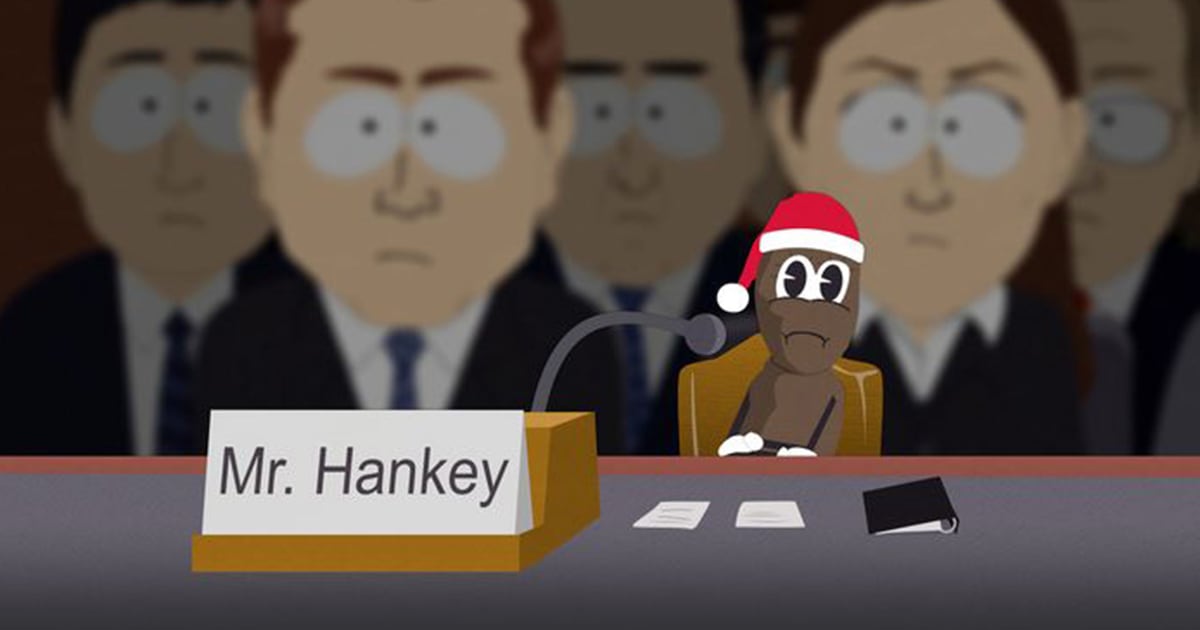
South Park opened its twenty-second season with a familiar target and a new twist, using Mr. Hankey, the Christmas Poo, to skewer three separate culture-war flashpoints: Roseanne Barr's social-media meltdown, Brett Kavanaugh's Senate testimony, and The Simpsons' long-running Apu controversy. The episode, titled 'The Problem With a Poo,' aired in October 2018 and deliberately echoed the title of comedian Hari Kondabolu's documentary, 'The Problem With Apu.' The title was not subtle, and neither was the episode's final image: Mr. Hankey arriving in Springfield, where Apu welcomes him as a fellow outcast, while the hashtag cancelthesimpsons appears on screen.
Key Facts
- The episode 'The Problem With a Poo' aired as part of South Park's twenty-second season in October 2018.
- Mr. Hankey, the Christmas Poo, is fired by the South Park City Council after posting offensive tweets and blaming Ambien.
- The storyline echoes Roseanne Barr's 2018 tweet scandal and her subsequent Ambien defense.
- Mr. Hankey's hearing parodies Brett Kavanaugh's angry appearance before the Senate Judiciary Committee.
- The episode ends with Mr. Hankey arriving in Springfield, where Apu welcomes him, and the hashtag cancelthesimpsons appears before the credits.
- The title references Hari Kondabolu's documentary 'The Problem With Apu,' which criticized The Simpsons' Apu stereotype.
A Christmas Poo Under Fire
Mr. Hankey has been a South Park fixture since the late 1990s, a singing, talking piece of Christmas feces who first appeared in the show's early seasons. In the episode, the South Park City Council informs him that the budget for his annual Christmas pageant has been cut. The officials tell him that some people find him offensive and that some people think his act is not the best representation of Christmas. The scene is played for laughs, but it also establishes the episode's central joke: a character who was once a beloved holiday mascot is now being re-evaluated by a community that has decided his brand is too problematic.
The parallel to Roseanne Barr is immediate. In May 2018, Barr posted a racist tweet about Valerie Jarrett, a former adviser to Barack Obama, and ABC canceled the revival of Roseanne. Barr later blamed Ambien for the post, a defense that became a punchline across late-night television and social media. South Park takes that defense and hands it to Mr. Hankey. After the boys discover that Mr. Hankey has been tweeting nasty things about them, including a derogatory message calling the children of South Park names and insulting their musical abilities, he offers an apology that sounds familiar. He says it was a bad attempt at a joke, asks Kyle to tell the kids he did not mean it, and then claims he could not sleep the night before, so he took some Ambien.
The show does not stop there. Mr. Hankey posts another offensive tweet, this time insulting the City Council members in crude terms, and the council fires him. He again blames Ambien. The repetition is the point. South Park is not interested in a nuanced debate about medication, impulse control, or the mechanics of social media. It is interested in the absurdity of a public figure who keeps posting inflammatory material and then reaches for the same excuse. The episode treats the Ambien defense as a comic routine, a way for a character to avoid responsibility while demanding sympathy.
Kyle's Stand and the 2018 Test
Kyle, the son of a lawyer, decides to represent Mr. Hankey in what the episode calls his defecation lawsuit. Kyle tells the other boys that Mr. Hankey messed up but may not deserve everything that is coming down on him. He says he wants to stand by his friend. Cartman's response is a cold dose of 2018 cynicism: he suggests they see how that goes for Kyle. The line works because it captures the mood of a year in which public figures were being disavowed, canceled, and re-litigated at a rapid pace. Kyle's instinct is loyalty, but the episode frames that loyalty as a risky position in a culture that had become quick to punish and slow to forgive.
The hearing that follows is a direct visual and rhetorical parody of Brett Kavanaugh's most recent appearance before the Senate Judiciary Committee. In September 2018, Kavanaugh testified after Christine Blasey Ford accused him of sexual assault. Kavanaugh denied the allegation, became combative, and described the proceedings as a smear campaign and a political hit. The South Park version turns that dynamic into a municipal hearing over a Christmas poo. A councilman asks Mr. Hankey whether he said everyone in South Park is a goddamn douchebag. Mr. Hankey replies that it was a bad attempt at a Christmas joke. Then he borrows Kavanaugh's language, asking whether people understand that the whole thing is a smear campaign and why they are focusing on a few stupid words when Christmas is just around the corner.
The parody works because it compresses the Kavanaugh hearing into a few absurd beats. The real hearing was heavy with questions about memory, temperament, partisanship, and credibility. The South Park version keeps the anger and the grievance but replaces the stakes with a holiday pageant and a character made of feces. The show is not making a legal argument about the Kavanaugh confirmation. It is mocking the rhetorical style that emerged from the hearing: the defensive fury, the claim of persecution, and the sudden invocation of a larger cause to deflect from specific conduct.
The Simpsons and the Apu Problem
The episode's title, 'The Problem With a Poo,' is a deliberate play on 'The Problem With Apu,' Hari Kondabolu's 2017 documentary. The film examined the long-running Simpsons character Apu Nahasapeemapetilon, the Indian-American convenience store owner voiced by Hank Azaria. Kondabolu argued that Apu was built on stereotypes and that the character had become a harmful representation for South Asian viewers. The documentary sparked a broader conversation about voice acting, representation, and the limits of satire. It also put The Simpsons on the defensive.
In April 2018, The Simpsons addressed the controversy in an episode called 'No Good Read Goes Unpunished.' In that episode, Lisa Simpson looks at a picture of Apu and says that something which started decades ago and was applauded and inoffensive is now politically incorrect. She asks what can be done. The response was widely criticized as dismissive, and it kept the Apu debate alive. South Park, which has never been shy about attacking other animated shows, steps into that fight with the final minutes of 'The Problem With a Poo.'
After Mr. Hankey leaves South Park, Stan asks where he will go. Randy replies that he will have to find a place that accepts racist, awful beings like him, adding that there are still places out there that do not care about bigotry and hate. The scene then cuts to Springfield, the home of The Simpsons. Mr. Hankey arrives, and Apu greets him. Apu tells him to rest his weary feet and make himself at home. The hashtag cancelthesimpsons appears on screen just before the credits roll. The implication is blunt: South Park is placing Apu in the same category as Mr. Hankey, a character whose offensive qualities have become too obvious to ignore.
The Broader Culture-War Target
The episode is not a single-issue satire. It is a collision of three stories that dominated the news cycle in 2018. Roseanne Barr represented the comedian whose revival was undone by a racist tweet. Brett Kavanaugh represented the Supreme Court nominee whose confirmation fight became a referendum on anger, entitlement, and credibility. The Simpsons represented the legacy property that was being asked to reckon with a character many viewers now saw as a stereotype. South Park uses Mr. Hankey as a bridge between all three, a character who is literally made of waste and who becomes a test case for how a culture handles offensive figures.
The show's creators, Matt Stone and Trey Parker, have built a career on equal-opportunity ridicule. They have targeted celebrities, politicians, religions, and other cartoons. In this episode, they are less interested in defending any of the targets than in exposing the patterns that connect them. The Ambien excuse, the smear-campaign complaint, and the defensive nostalgia for a time when a character was considered harmless all become part of the same comic vocabulary. South Park is saying that the language of grievance and victimhood can be used by anyone, even a Christmas poo.
The episode also reflects a shift in how audiences talk about cancellation. In 2018, the term was becoming a common shorthand for public backlash, lost jobs, and revoked deals. South Park does not offer a clear position on whether cancellation is good or bad. It simply shows the cycle: a character says something offensive, faces consequences, claims he was misunderstood, and then finds a new home among people who are willing to overlook his history. The final joke is that Springfield, the setting of another long-running animated show, is that home.
Why the Episode Stood Out
South Park has often been most effective when it moves quickly. The show's production schedule allows it to respond to news within days, and that speed can give its satire a raw, immediate energy. 'The Problem With a Poo' aired only weeks after the Kavanaugh hearing and months after the Roseanne cancellation. It also arrived more than a year after the Apu documentary and several months after The Simpsons' defensive response. By combining those stories, the episode did something that a standard late-night monologue could not: it turned the news into a narrative with a beginning, a middle, and a final visual punchline.
The episode's use of Mr. Hankey is also a reminder of how South Park has changed. In the early seasons, Mr. Hankey was a cheerful, absurd holiday character. By 2018, he could be used as a stand-in for a public figure who had worn out his welcome. The show did not need to create a new character to make its point. It reached back into its own history and repurposed a familiar face, or in this case, a familiar piece of feces, to comment on the present. That is part of South Park's signature approach: it treats its own canon as a toolbox for whatever argument it wants to make that week.
The final image of Mr. Hankey in Springfield is not a resolution. It is a joke with a sharp edge. Apu welcomes him, and the hashtag appears. The episode does not show what happens next, and it does not pretend to solve the debates it has raised. It simply leaves the viewer with the connection: a character accused of racism is given shelter by another character accused of racism. The satire is not subtle, but South Park has rarely been subtle. The episode ended with that image, a hashtag, and a clear invitation for the audience to argue about what it all meant.
Source: The Daily Beast News